

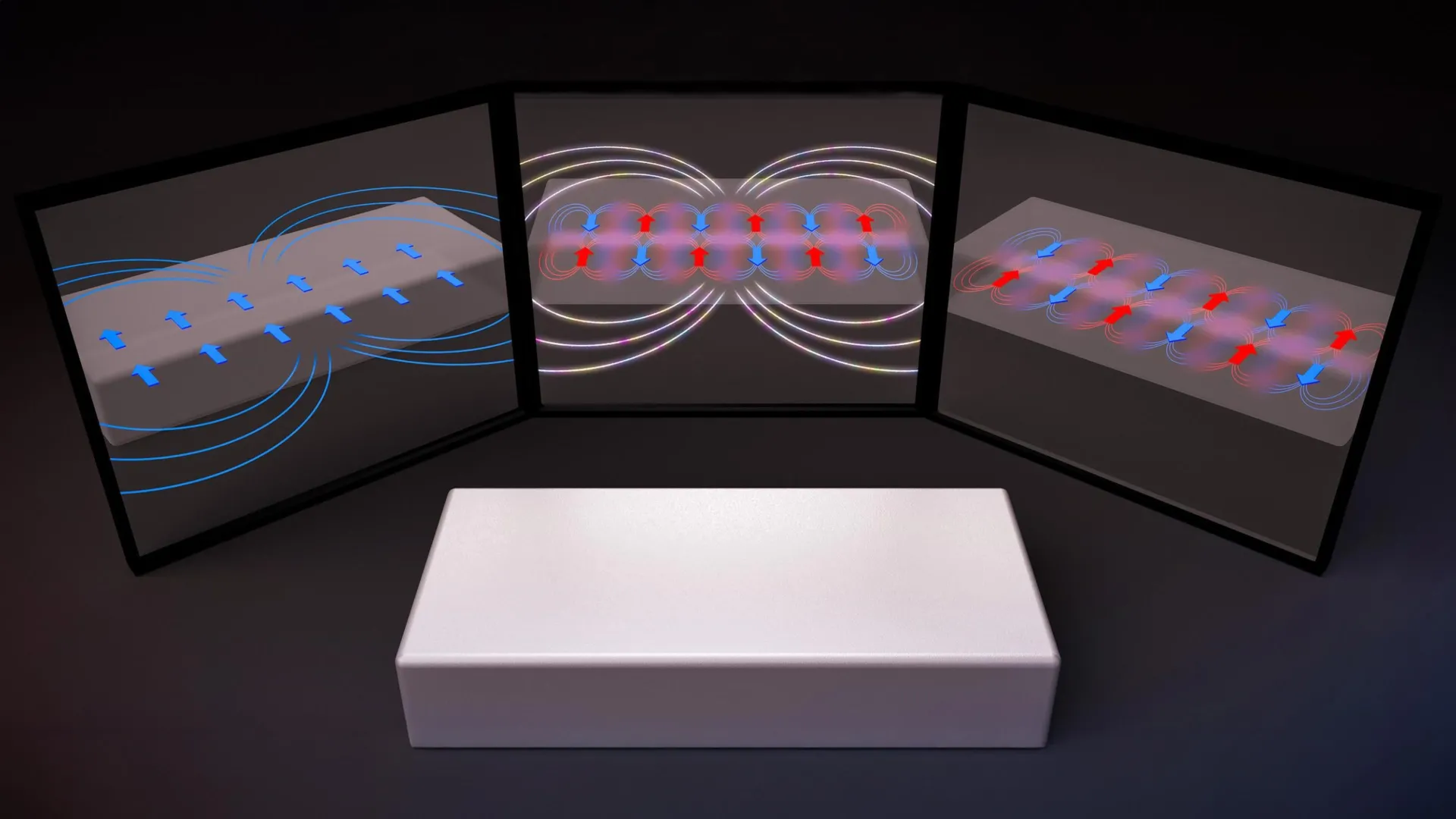
Researchers at the U.S. Department of Energy’s SLAC National Accelerator Laboratory have published findings that confirm the existence of a previously theoretical third category of magnetic materials. The discovery, detailed in a Science publication, identifies altermagnetism as a distinct magnetic phase that combines characteristics of the two traditionally recognized types: ferromagnetism and antiferromagnetism. Lead author Daniel Jost noted that while observations suggesting a third magnetic type have accumulated in recent years, the new research provides definitive experimental confirmation.
The conventional understanding of magnetism has rested on two main categories for approximately 90 years. Ferromagnetic materials align electron spins in the same direction, producing a detectable external magnetic field familiar from everyday magnets. Antiferromagnetic materials, identified in 1933, feature opposing electron spins that cancel each other out, resulting in no overall magnetization. In recent years, however, scientists observed materials exhibiting properties of both types simultaneously, displaying alternating electron spins while also supporting spin currents typically associated with ferromagnetic behavior.
The key distinction of altermagnets lies in their atomic arrangement. While they share the alternating spin orientations of antiferromagnets, the crystal structures surrounding the oppositely aligned spins are rotated relative to one another. This structural rotation breaks a symmetry present in conventional antiferromagnets, fundamentally altering electron behavior and enabling the combination of previously incompatible properties. The term “altermagnets” was introduced in 2022 to describe this proposed third magnetic class.
To confirm altermagnetism, the research team needed to establish a definitive distinguishing characteristic. They identified chirality—a form of asymmetry analogous to handedness in human hands—as the signature feature. Using circularly polarized X-rays at the European Synchrotron Radiation Facility in France, researchers examined manganese telluride, a material previously classified as antiferromagnetic. The experiments revealed that the material scattered left-handed and right-handed polarized X-rays differently, providing the chiral signature expected from altermagnetism and absent in conventional antiferromagnets.
Beyond its significance for fundamental physics, the finding has potential applications in developing magnetic materials for advanced computing, quantum devices, and energy-efficient data centers. The confirmation of altermagnetism as a distinct magnetic phase opens new possibilities for technological development leveraging previously unrecognized material properties.
Article Attribution | Read More at Article Source
Article summary produced by Claude AI