

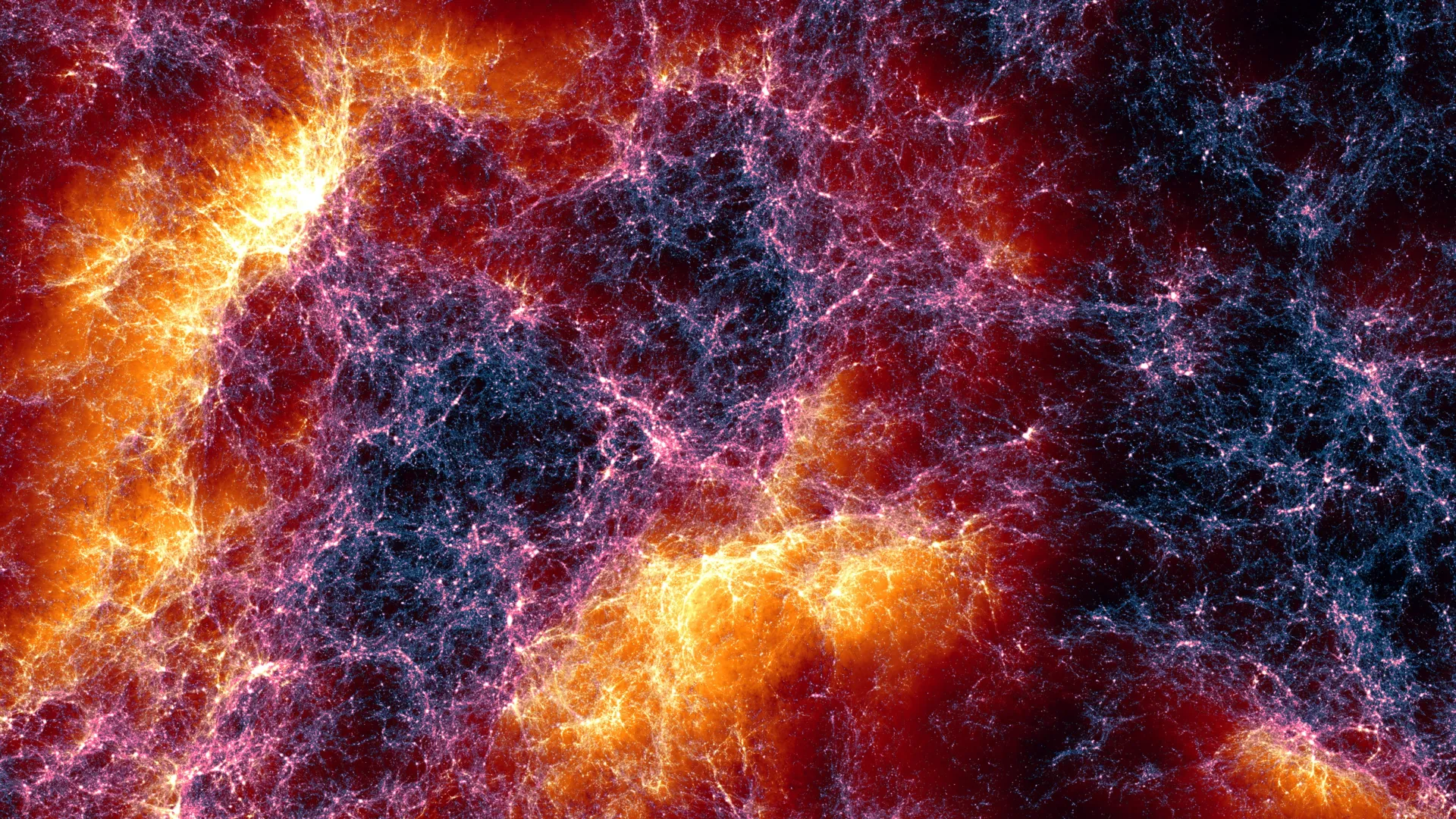
Researchers at the Center for Astrophysics | Harvard & Smithsonian have developed Lumina, described as one of the largest and most detailed simulations of the early universe ever created. The simulation reconstructs the cosmos during its first 2 billion years by modeling interactions between ordinary matter, dark matter, and radiation. Results from the research were published in Monthly Notices of the Royal Astronomical Society.
The simulation was designed to assist astronomers in interpreting data from powerful observatories including the James Webb Space Telescope and the Nancy Roman Space Telescope. By comparing Lumina’s predictions against actual telescope observations, scientists can assess how well current theories account for cosmic evolution and identify observations that may challenge existing understanding of fundamental physics. The virtual universe spans a cube approximately 1.5 billion light-years on each side, making it more than 100 times larger than earlier comparable simulations.
A notable advancement in Lumina involves its treatment of helium reionization, a process during which radiation removes electrons from helium atoms. The simulation follows this transformation across an enormous volume while simultaneously accounting for its effects on the surrounding universe, marking the first time such a large-scale model has tracked both hydrogen and helium transformation while resolving individual galaxies. The project required extraordinary computational resources, utilizing more than 15,000 graphics processing units on Frontier, one of the world’s fastest supercomputers located at Oak Ridge National Laboratory in Tennessee.
Researchers plan to use Lumina to investigate gas movement between galaxies, the influence of residual radiation from the Big Bang, and the emergence of regions with exceptionally high star formation rates. By systematically comparing simulated results with real telescope observations, scientists aim to develop a more comprehensive understanding of the universe’s earliest periods and potentially identify areas where current theories require refinement.
Article Attribution | Read More at Article Source
Article summary produced by Claude AI