

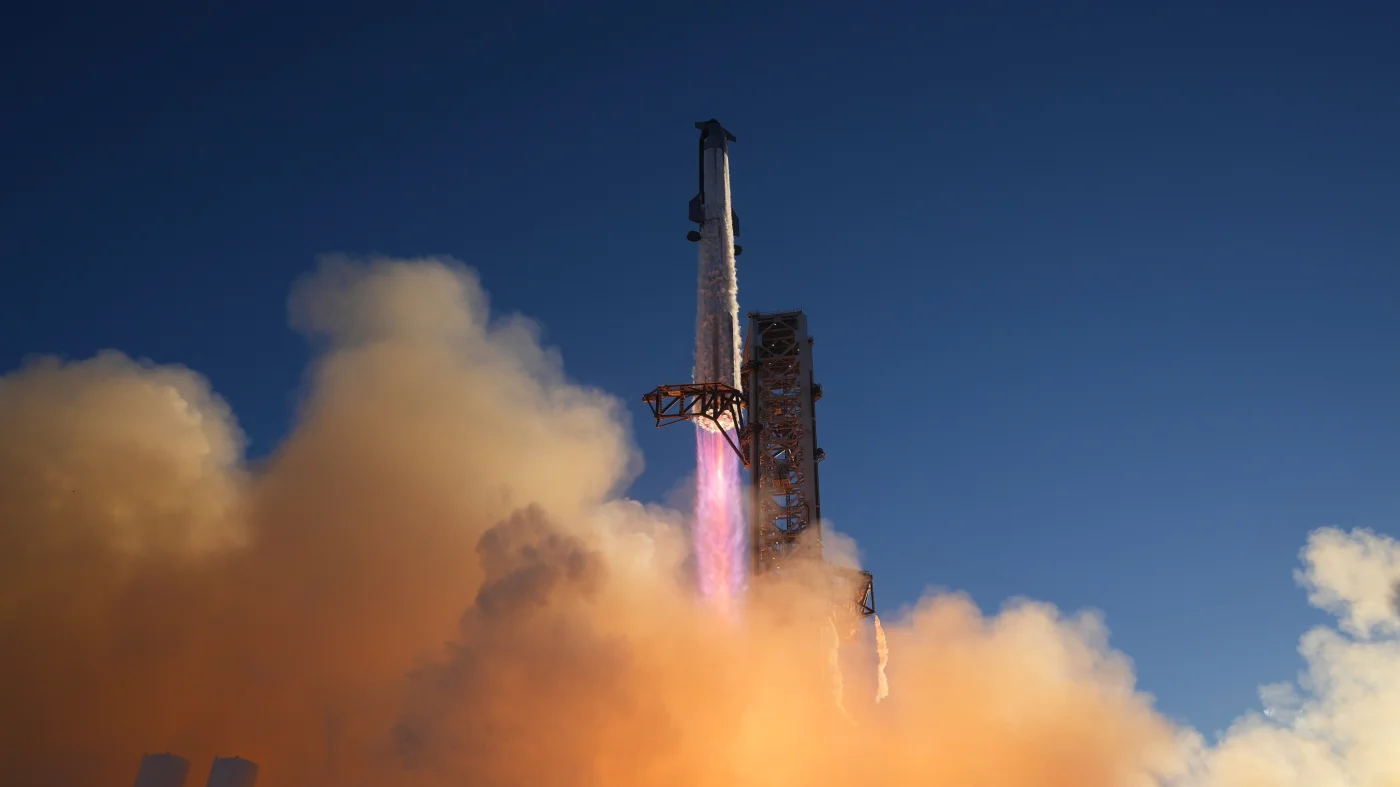
SpaceX achieved a significant milestone when its Starship spacecraft returned to Earth and was captured by mechanical arms at its launch site on Saturday, approximately 22 hours after lifting off from the company’s Texas facility on Friday. The upper-stage vehicle completed 14 orbits around Earth at an altitude of 165 miles, releasing 26 Starlink satellites during the mission. SpaceX officials characterized the successful catch as a demonstration of Starship’s full reusability potential, a capability central to the company’s plans for lunar and Mars exploration.
The achievement was tempered by a failure during the same flight. The first-stage booster, which had separated from the upper-stage spacecraft earlier in the ascent, experienced an engine shutdown during its return sequence. According to SpaceX engineers, the guidance system detected that the booster was not in the proper position for recovery and initiated an automated self-destruct sequence, sending the vehicle into the Gulf of Mexico. Investigation into the root cause of the premature engine shutdown was ongoing. Despite this setback, SpaceX had previously succeeded in recovering boosters on three prior occasions, establishing the viability of the capture technique.
This represented the 15th full-scale Starship flight test since 2023 and only the second successful orbital mission. Telemetry indicated that the spacecraft’s systems, including its heat shield, performed as expected during the flight. NASA confirmed its satisfaction with the progress, noting that the space agency is investing substantial resources in Starship to support its Artemis lunar program, which aims to return astronauts to the moon’s surface later this decade and establish a sustained presence there.
SpaceX indicated plans to initiate Starship launches from Kennedy Space Center in Florida within the following months. Those missions will support NASA’s Artemis program objectives, with subsequent flights involving docking procedures with both SpaceX’s Starship and Blue Origin’s Blue Moon lunar lander as part of NASA’s strategy for delivering crews to the lunar surface.
Article Attribution | Read More at Article Source
Article summary produced by Claude AI