

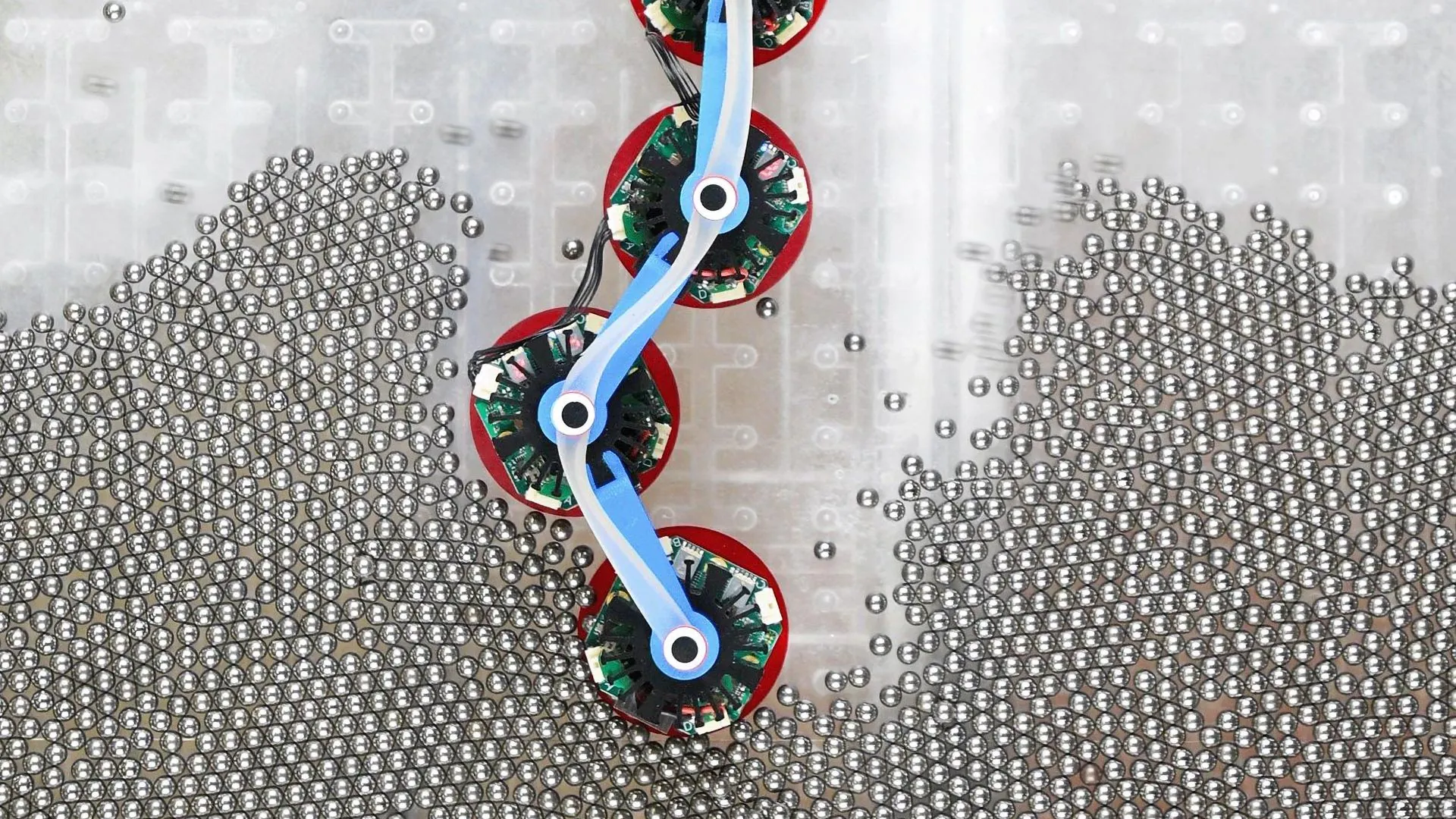
Researchers from universities in Amsterdam, New South Wales, and Cambridge have made significant advances in understanding active matter—materials that use internal energy sources to respond to external forces in ways passive materials cannot. Unlike conventional substances such as metal or concrete that require external forces to change shape, active matter can generate movements autonomously, mimicking behaviors observed in natural systems like flocking birds.
In one major discovery, the team constructed chains of connected rods with small motors positioned at the joints between neighboring rods. The motors created asymmetrical interactions where moving one rod affected its neighbor differently than the reverse movement would. When external forces acted on these structures, they produced continuous oscillations rather than single buckling and snapping events, generating movements resembling crawling, walking, and digging. This behavior occurs due to a transformation of the system’s critical point into what researchers term a critical exceptional point. The findings suggest a pathway toward designing soft robots capable of performing complex movements without centralized control systems.
A second study revealed that active materials violate Le Chatelier’s Principle, a fundamental engineering rule suggesting that changes to individual components produce proportional changes in overall structure behavior. The researchers constructed two-dimensional lattice networks of motors and rods to test this principle. They discovered that increasing the activity of individual components did not always increase the material’s overall activity.
The key to this counterintuitive behavior involves percolation—the ability of responses to travel through connected pathways within the material. Similar to how water finds paths through coffee grounds, mechanical responses in active materials depend on whether interconnected components form continuous channels for transmission. If components with low activity disrupt these pathways, even highly active elements may fail to influence the entire structure. This research indicates that component connectivity and distribution can be as important as individual properties in determining overall material behavior.
Both studies have been published in peer-reviewed journals, with the first study appearing in the Proceedings of the National Academy of Sciences and the second in Physical Review X.
Article Attribution | Read More at Article Source
Article summary produced by Claude AI