

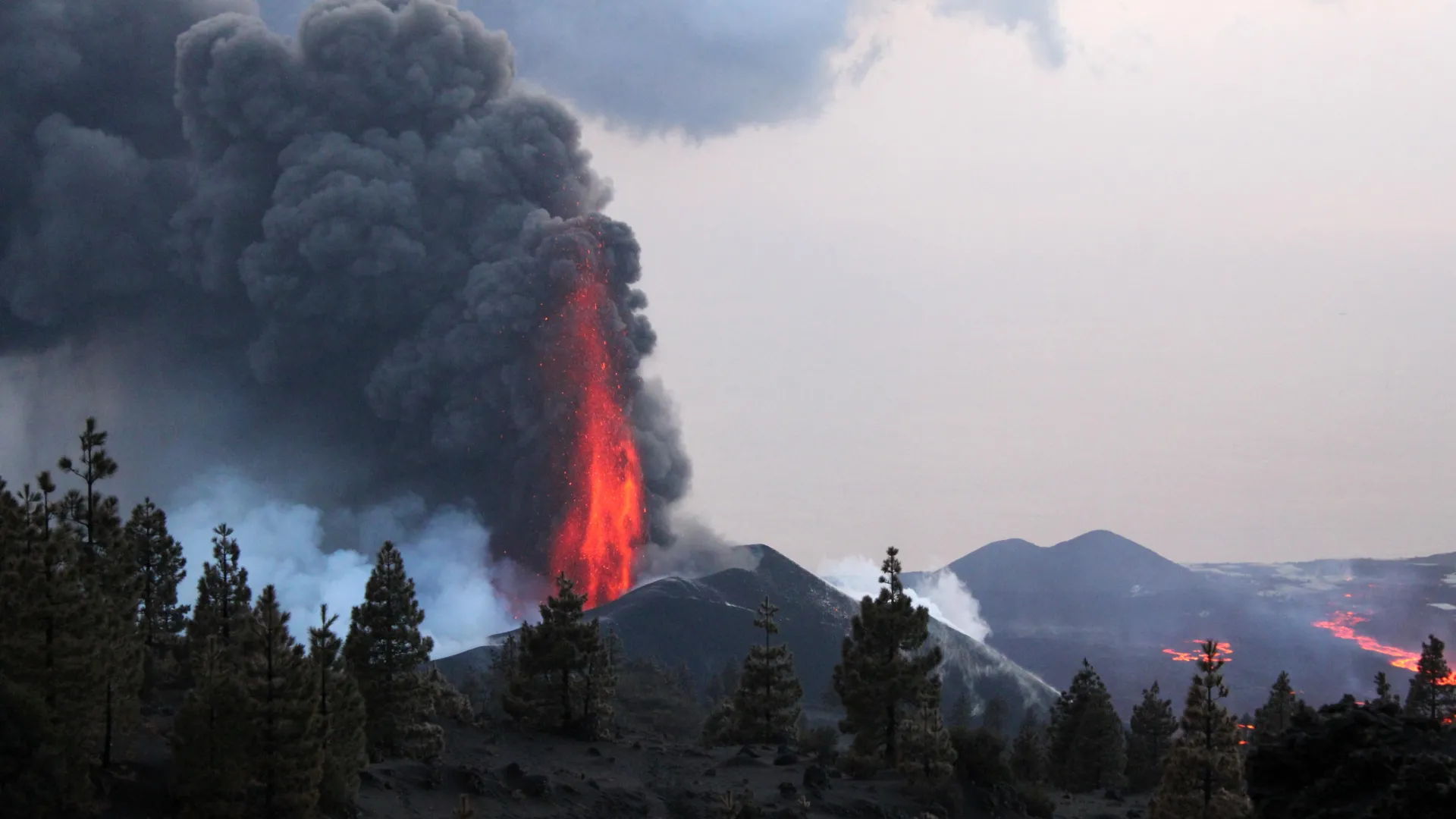
An international research team led by The University of Manchester has identified a process called superheating that may explain why some volcanoes produce towering lava fountains while others release molten rock more gently. The researchers analyzed volcanic material from the 2021 Tajogaite eruption on La Palma, Spain, and found that extreme temperatures can dramatically slow crystal formation inside magma as it travels toward Earth’s surface. Their findings were published in Nature Communications.
Superheating occurs when magma reaches temperatures above the threshold at which its crystals would normally remain stable. This extreme heat can dissolve microscopic crystal seeds and alter the internal structure of molten material, making it less favorable for new crystal formation. The researchers used synchrotron X-ray microtomography at Diamond Light Source to observe these processes in real time within specially designed pressure vessels that allow X-rays to pass through them. Laboratory experiments showed that normal magma began producing crystals after approximately 20 minutes, while superheated magma experienced a delay of more than eight hours in crystallization.
The timing of crystal formation significantly affects magma’s viscosity, or how easily it flows. As crystals develop, magma becomes thicker and more resistant to movement, which influences both its speed of ascent and how trapped volcanic gases escape. The research team incorporated their laboratory findings into computer models simulating magma rise through Earth’s crust. These simulations revealed that when superheating delays crystallization, magma remains relatively fluid and can travel upward more rapidly, creating conditions favorable for dramatic lava fountains. In contrast, magma that crystallizes earlier becomes more viscous, ascends more slowly, and allows gases additional time to escape, favoring gentler eruptions characterized by flowing lava.
The discovery has implications for volcanic hazard assessment and eruption forecasting. Scientists currently monitor earthquakes, ground deformation, and volcanic gas emissions to identify changes in active volcanoes, but predicting how eruptions will unfold remains challenging. Two volcanoes with similar magma compositions and gas conditions can display markedly different eruptive behavior. The researchers suggest that understanding superheating effects and crystal formation timing should receive greater attention in volcanic forecasting models to improve eruption predictions.
Article Attribution | Read More at Article Source
Article summary produced by Claude AI