

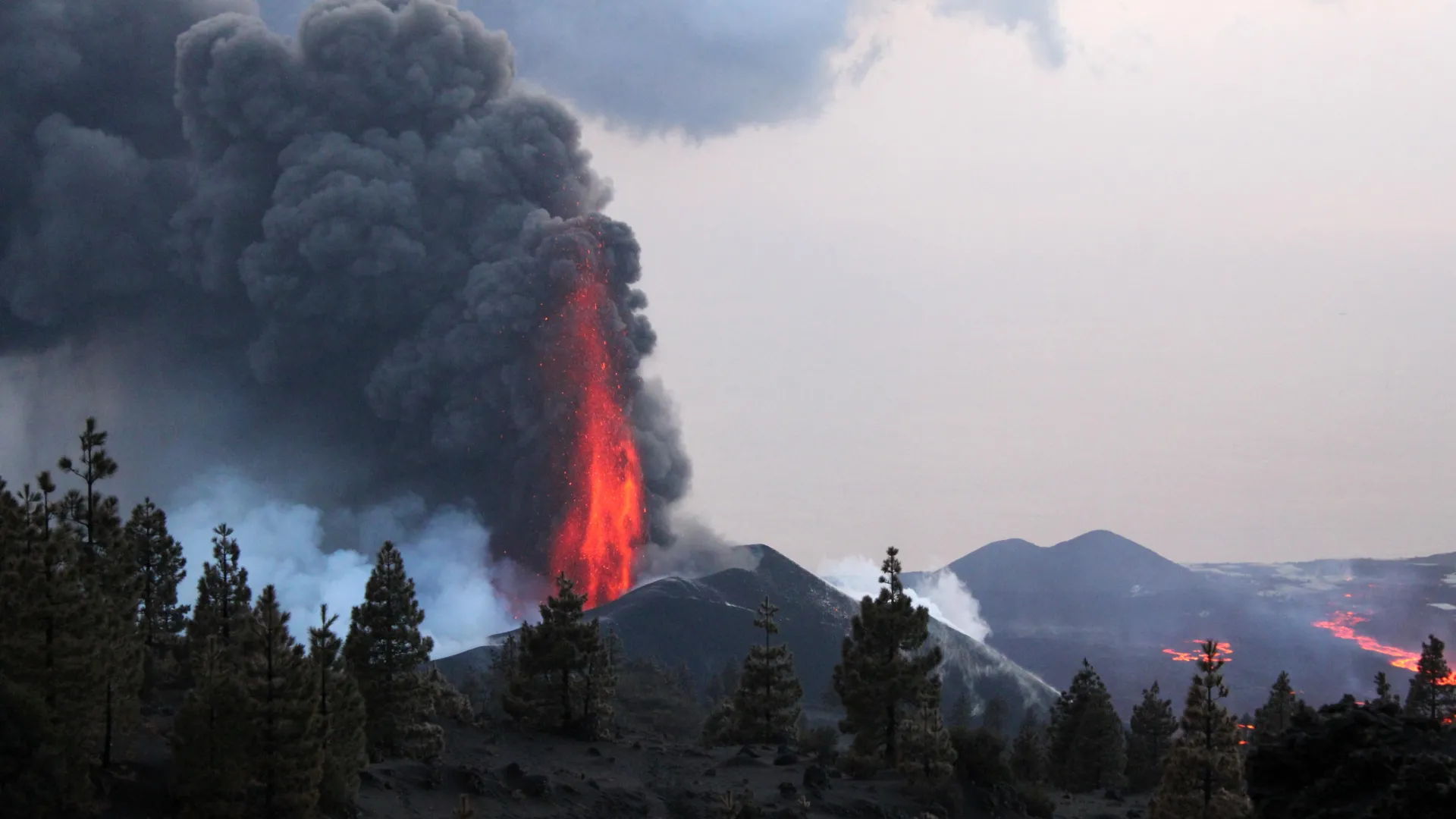
An international research team from The University of Manchester has identified a mechanism that may explain why some volcanoes produce towering lava fountains while others erupt more gently. The researchers studied volcanic material from the 2021 Tajogaite eruption on La Palma, Spain, and found that a process called superheating—in which magma reaches temperatures above those required for crystal stability—can significantly delay the formation of crystals as the molten rock travels toward Earth’s surface.
Superheating affects magma through two primary mechanisms. Extremely high temperatures can dissolve microscopic crystal seeds that would normally encourage new crystal growth, and the heat also alters the internal structure of the molten material, making it less favorable for crystallization. Since crystals influence magma’s viscosity and flow characteristics, delays in crystal formation can have major consequences for how a volcano erupts. Using advanced laboratory techniques at Diamond Light Source and additional experiments in Prague, the research team observed that unsuperheated magma began forming crystals after approximately 20 minutes, whereas superheated magma experienced a crystallization delay exceeding eight hours.
The researchers incorporated their findings into computer models simulating magma ascent through Earth’s crust. The simulations revealed that when superheating prevents early crystallization, magma remains relatively fluid and can rise more rapidly, potentially creating conditions favorable for dramatic lava fountains propelled by escaping volcanic gases. Conversely, magma that crystallizes earlier becomes thicker and rises more slowly, allowing gases additional time to escape and favoring gentler, flowing eruptions rather than explosive fountains.
The discovery, published in Nature Communications, suggests that volcanic systems with similar chemical compositions and gas conditions may nevertheless display markedly different eruptive behavior depending on their heating histories. Researchers indicate that understanding these pre-eruption processes could improve volcanic forecasting models, as scientists currently rely on monitoring earthquakes, ground deformation, and gas emissions to assess volcanic hazards and predict eruption characteristics.
Article Attribution | Read More at Article Source
Article summary produced by Claude AI