

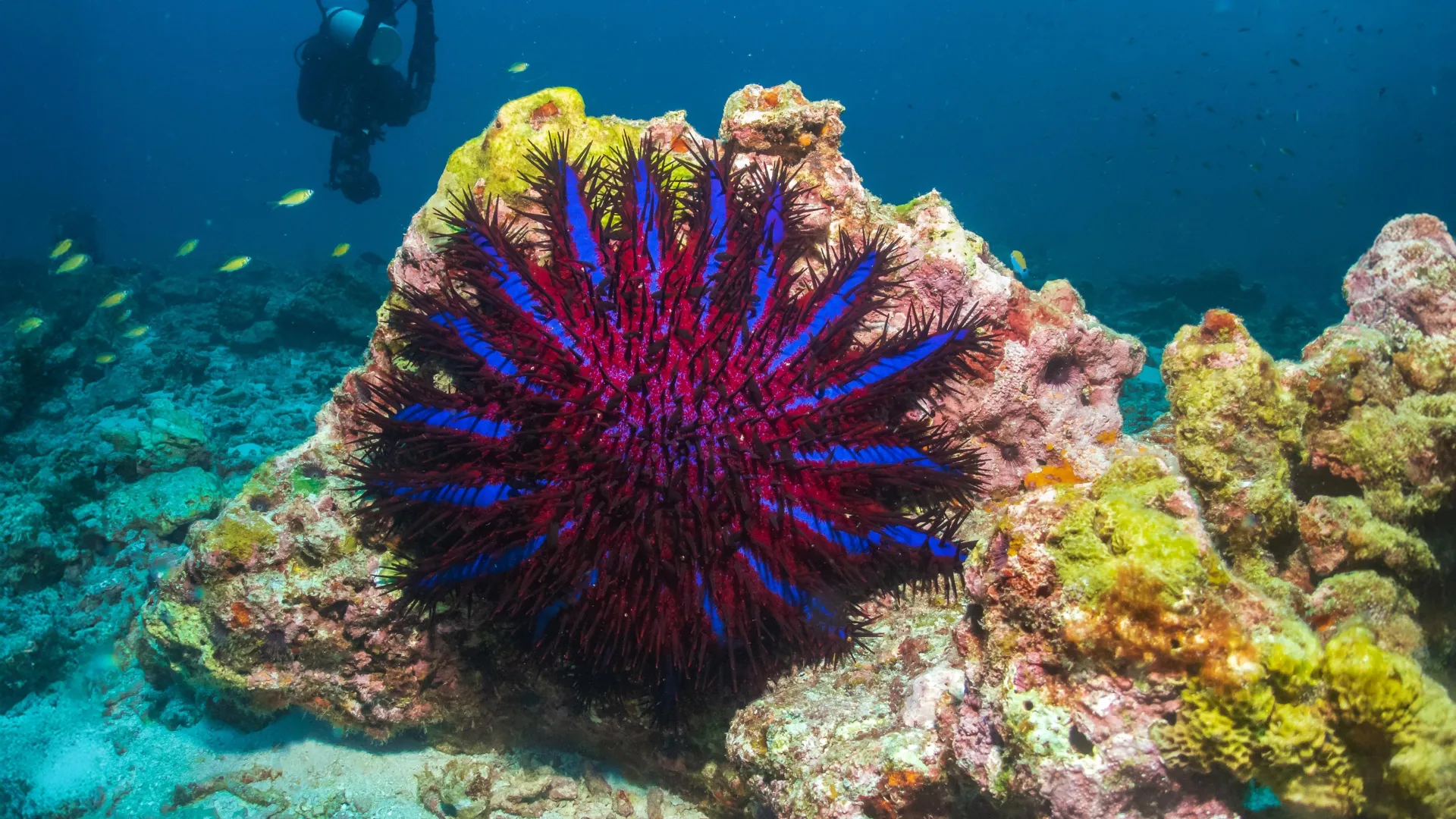
Crown-of-thorns starfish, long considered among the most destructive creatures on coral reefs, may play a beneficial ecological role when their populations remain at naturally manageable levels, according to research from the University of Sydney. The starfish are covered in sharp, toxin-filled spines and feed on coral, but have historically caused severe damage during population explosions. The Great Barrier Reef has experienced four major outbreaks since the 1960s, roughly every 15 years, driven partly by declining populations of natural predators.
A study published in Ecology and Evolution examined feeding patterns at One Tree Island Research Station on the Great Barrier Reef, focusing on protected areas where healthy fish populations keep starfish numbers under control. Researchers led by Dr. Shawna Foo discovered that living coral tissue survived approximately 75 percent of observed feeding events. Rather than destroying entire coral colonies, the starfish consumed moderate amounts of coral and moved on, frequently leaving living tissue behind.
The findings suggest that low-density populations of crown-of-thorns starfish may help maintain coral reef biodiversity. Fast-growing coral species like Acropora can dominate reef areas and limit space for slower-growing varieties. By feeding on these dominant corals, the starfish create opportunities for species such as Montipora and Porites to survive and establish themselves. The researchers found that damaged fast-growing coral did not regenerate in areas where starfish had fed, while slower-growing corals showed signs of regrowth.
The results align with the intermediate disturbance hypothesis, an established ecological principle suggesting that moderate, periodic disturbances can maintain ecosystem diversity by preventing single species dominance. Scientists emphasize that large-scale crown-of-thorns outbreaks remain a serious threat to reef health. However, the research suggests that complete elimination of starfish populations may not be optimal once an outbreak is controlled. Instead, conservation strategies should focus on maintaining naturally low population levels through strong marine management and protection of starfish predators.
Article Attribution | Read More at Article Source
Article summary produced by Claude AI