

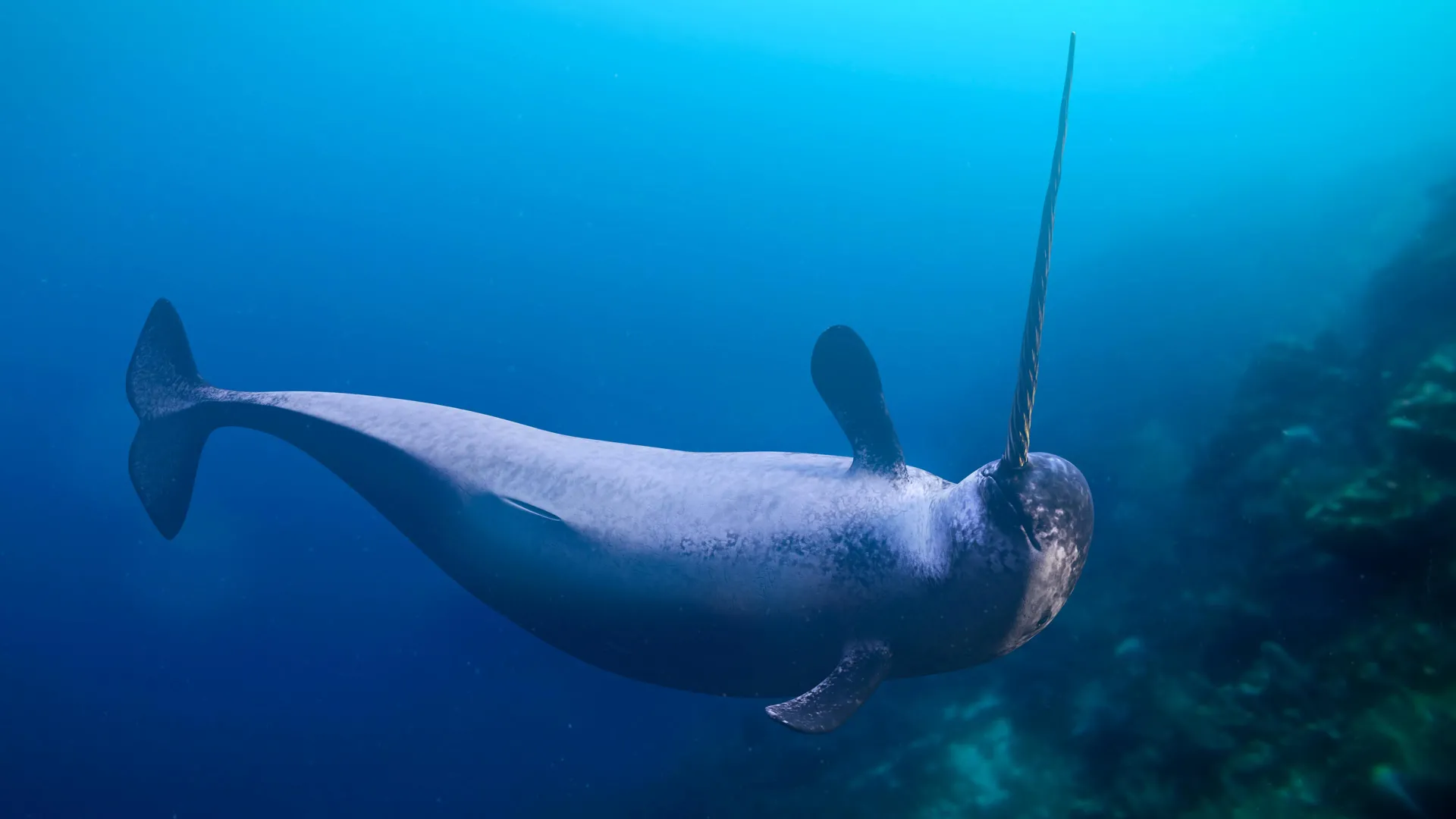
Scientists have uncovered the remarkable engineering behind the narwhal’s distinctive tusk, revealing how microscopic biological components create one of nature’s most unusual dental structures. The research, conducted by an international team across three major European synchrotron facilities, employed advanced X-ray imaging techniques to analyze the internal architecture of these extraordinary teeth.
The narwhal tusk, which can reach two meters in length and grow throughout the animal’s lifetime, is not actually a horn but an elongated tooth. Unlike other elongated teeth in nature, which typically grow in curved patterns, the male narwhal develops a remarkable corkscrew-shaped upper left canine that twists counterclockwise as it extends forward through the upper lip. This visible spiral structure captured the attention of researchers seeking to understand how the tusk’s microscopic components could explain its distinctive form.
Using tensor tomography at the Swiss Light Source, MAX IV Laboratory, and the European Synchrotron Radiation Facility, the team discovered an unexpected architecture. Rather than containing a single spiral arrangement, the tusk’s microscopic building blocks form two intertwined helices that twist in opposite directions, creating an exceptionally stable composite structure. The tusk consists primarily of dentin with an outer layer of cementum, both reinforced by fine collagen fibers and mineral crystals that work together to provide both strength and flexibility, much like steel reinforcement in concrete.
The findings, published in Nature Communications, explain how the tusk can withstand the strong hydrodynamic forces generated by swimming. While the precise biological purpose of these elaborate tusks remains uncertain, evidence suggests they play a primary role in mate selection and social interactions, as narwhals have been observed crossing tusks in playful duels. The discovery represents a significant advancement in understanding how complex microscopic arrangements at the nanometer scale produce the visible structures that characterize these Arctic mammals.
Article Attribution | Read More at Article Source
Article summary produced by Claude AI