

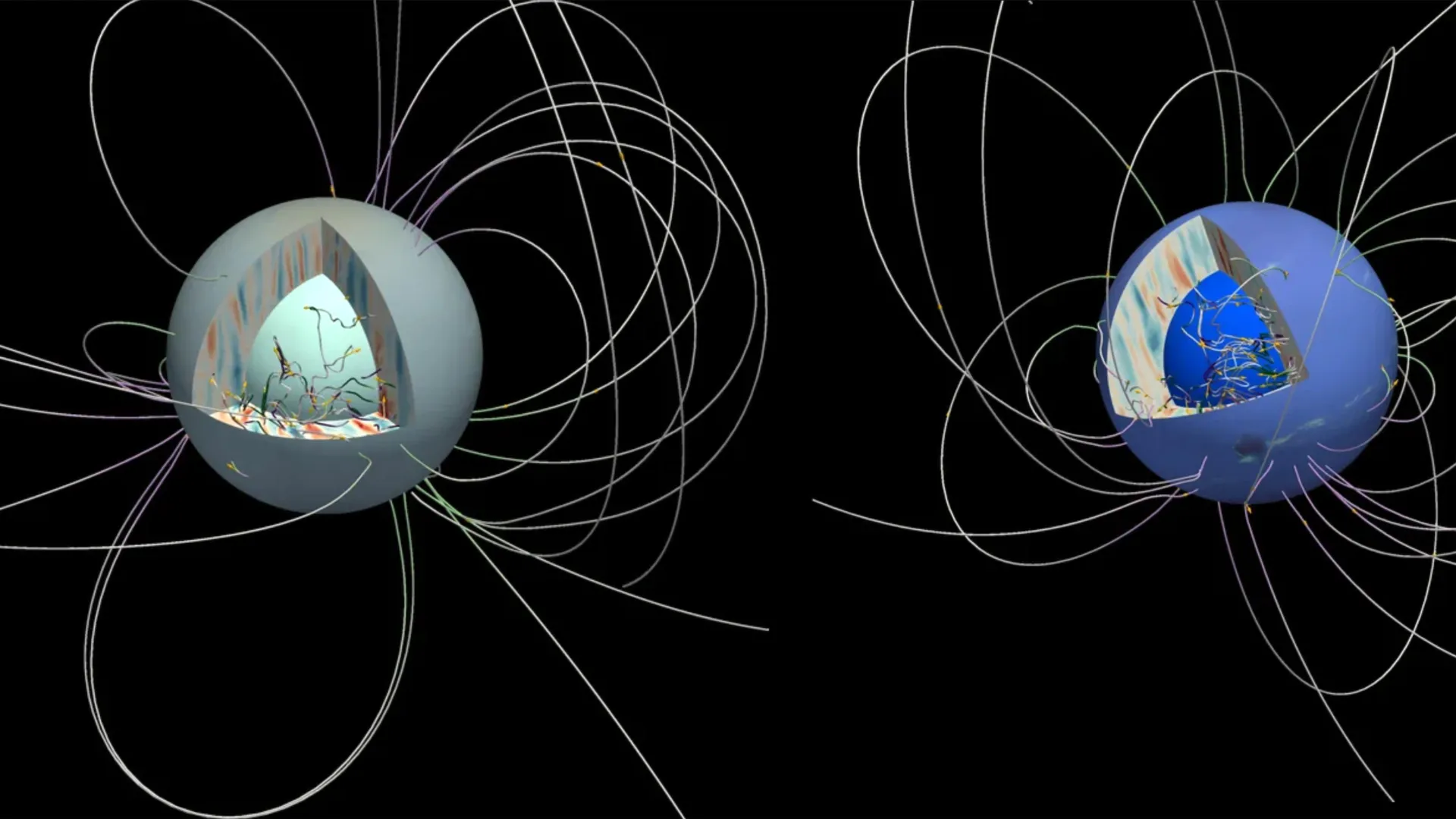
Scientists have long puzzled over the distinctive magnetic characteristics of Uranus and Neptune, which differ markedly from Earth’s relatively orderly magnetic field. When NASA’s Voyager 2 spacecraft encountered these ice giants in the 1980s, it detected magnetic fields that were severely tilted and distorted compared to Earth’s field, which remains aligned closely with the planet’s rotation axis. Uranus exhibits a magnetic tilt of 59 degrees from its rotation axis, while Neptune’s magnetic field tilts by 47 degrees, contrasting sharply with Earth’s 11-degree tilt.
Researchers from The University of Texas at Austin and collaborating institutions have proposed a new explanation based on the extreme internal conditions of these distant worlds. The ice giants contain combinations of hydrogen, helium, water, ammonia, methane, and rocky material under pressures and temperatures far exceeding those found on Earth. According to the new study published in Communications Physics, electrical conductivity within these planets may increase significantly at greater depths, fundamentally altering how their magnetic fields are generated. This change in conductivity could account for the dramatically tilted and distorted magnetic configurations observed by Voyager 2.
Perhaps most striking is the research team’s finding that the magnetic fields of Uranus and Neptune may be considerably less stable than Earth’s field. Computer simulations suggest that these planets’ magnetic axes could shift by tens of degrees within periods of only a few decades, contrasting with Earth’s magnetic tilt, which drifts by roughly one degree per 50 years. This raises the possibility that the magnetic environments surrounding these ice giants today differ substantially from those measured decades ago.
To test these predictions, researchers are now analyzing detailed infrared observations from the James Webb Space Telescope, focusing particularly on the planets’ auroras. These glowing atmospheric features form when charged particles interact with planetary atmospheres and are directly connected to underlying magnetic fields. Changes in aurora patterns since the Voyager 2 era could provide evidence of magnetic shifts. Scientists note that comprehensive understanding of these distant worlds will ultimately require new spacecraft missions, but current simulations and telescope observations may help resolve one of the solar system’s most intriguing magnetic puzzles.
Article Attribution | Read More at Article Source
Article summary produced by Claude AI