

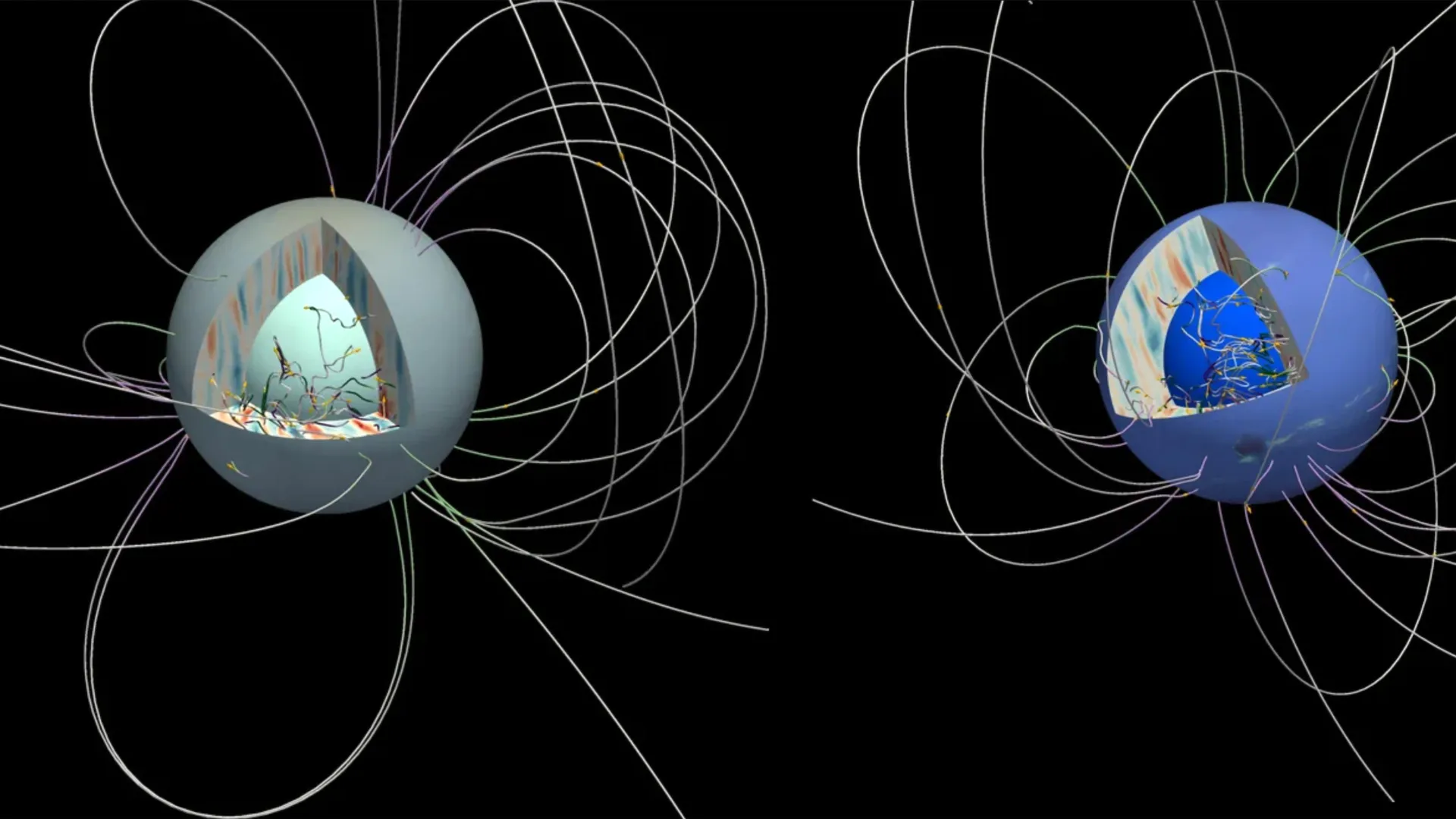
When NASA’s Voyager 2 spacecraft visited Uranus and Neptune in the 1980s, it documented planetary magnetic fields with unusual characteristics. Unlike Earth’s relatively stable and orderly magnetic system, both ice giants possess fields that are dramatically tilted and distorted. Earth’s magnetic dipole tilts only 11 degrees from its rotation axis, whereas Uranus exhibits a 59-degree tilt and Neptune a 47-degree tilt. Scientists have long puzzled over the origin of these extreme deviations.
A new investigation led by researchers at The University of Texas at Austin, in partnership with institutions including UCLA, Imperial College London, and Northumbria University, proposes an explanation based on the extreme conditions present deep within these worlds. The study, published in Communications Physics, suggests that changes in electrical conductivity at extreme pressures and temperatures may drive the generation of the planets’ anomalous magnetic fields. Under the enormous pressures found in ice giant interiors, water molecules break apart into ions—electrically charged particles capable of carrying electrical current. The research team developed computer simulations incorporating varying electrical conductivity at different depths within the planets’ interiors, testing how this factor influences magnetic field generation alongside other variables such as fluid circulation and temperature gradients.
The simulations produced results consistent with observations from Voyager 2, lending support to the conductivity hypothesis. A particularly striking finding emerged from the modeling: the magnetic fields of Uranus and Neptune may be substantially less stable than Earth’s magnetic system. The simulations indicate that the magnetic poles of these ice giants could shift by tens of degrees within only a few decades, contrasting sharply with Earth’s gradual magnetic drift of approximately one degree per 50 years.
To test whether such changes have occurred since the Voyager 2 encounters, researchers are now analyzing infrared observations captured by the James Webb Space Telescope. The investigation focuses on auroras—glowing atmospheric features produced when charged particles interact with planetary atmospheres—which respond to changes in underlying magnetic fields. Alterations in aurora shape, structure, or patterns could provide evidence of magnetic pole shifts. Scientists plan to integrate Webb’s auroral data with Voyager 2’s original measurements and the new simulations to develop a more comprehensive understanding of the planets’ current magnetic configurations. Researchers acknowledge that definitively resolving questions about these ice giants’ deep interiors will ultimately require dedicated spacecraft missions.
Article Attribution | Read More at Article Source
Article summary produced by Claude AI