

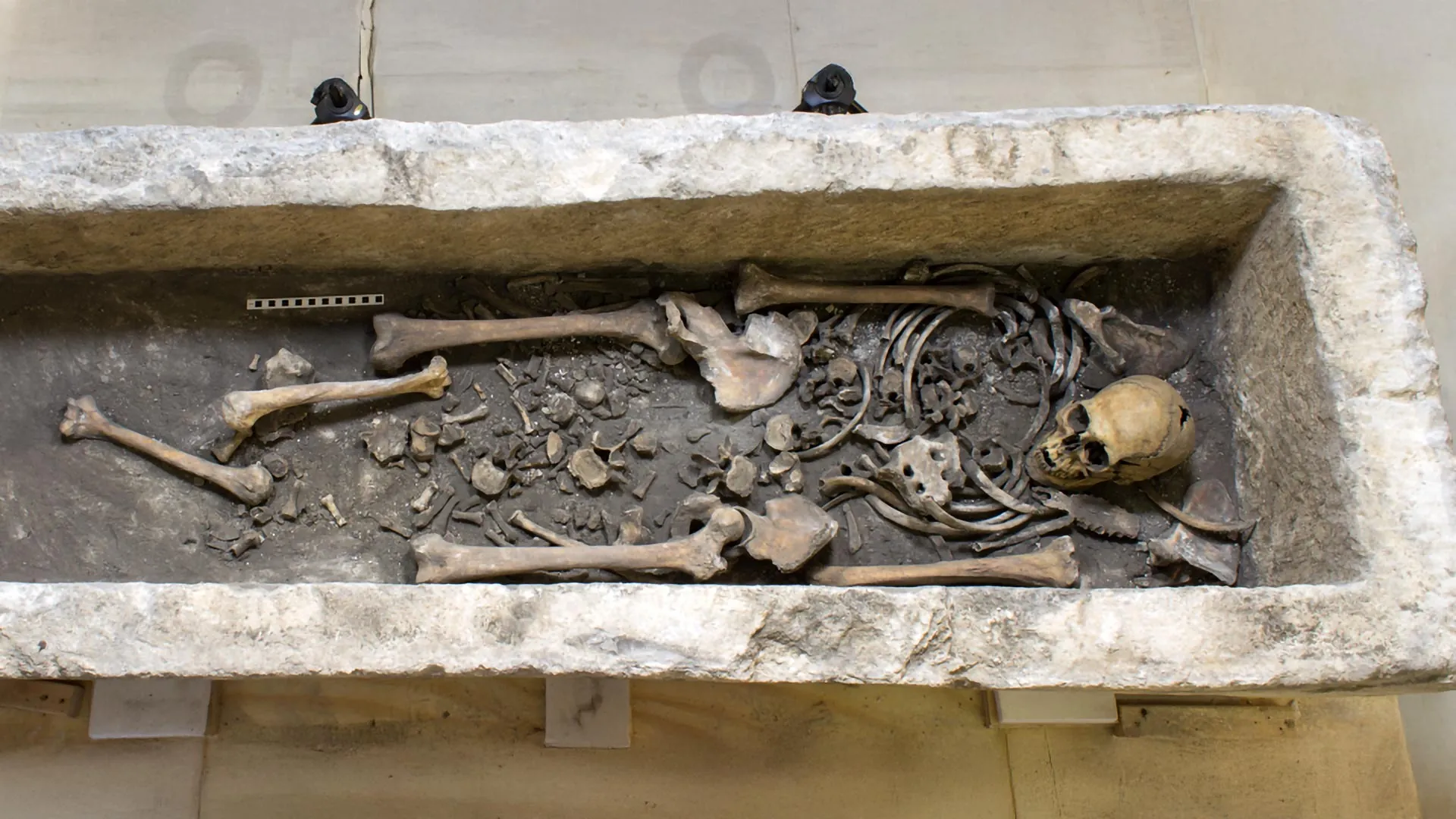
Researchers have made significant progress in identifying the skeleton discovered within an ancient Roman limestone sarcophagus at Westminster Abbey, formally excavated in 1869. The coffin bears an inscription naming Valerius Amandinus, a wealthy Briton from between 300 and 400 AD, yet a Latin cross carved into its lid dates to approximately the 10th or 11th century, indicating the actual burial occurred centuries after the sarcophagus was originally created.
According to new findings published in the Journal of the British Archaeological Association, the remains most likely belong to a prominent medieval monk, with researchers identifying two possible candidates. Professor Warwick Rodwell, Consultant Archaeologist at Westminster Abbey, points to Aelfwig, an abbot who died around 1020, as the strongest contender, though Wulnoth, his successor who died in 1049, remains a viable alternative. Both men served as abbots of Westminster Abbey during the late Saxon period and would have warranted the honor of burial in an elaborate Roman sarcophagus.
Recent skeletal analysis conducted by Pre-Construct Archaeology revealed that the deceased was a male aged 35 to 49 years old, standing approximately 5 feet 9 inches tall. These findings differ substantially from 19th-century assessments that characterized the remains as belonging to a younger man. Radiocarbon dating of a bone sample produced a date range of 987 to 1052 AD, placing the burial firmly within the late Saxon period and aligning precisely with the deaths of both identified candidates.
The investigation revealed that the sarcophagus was repurposed to honor an important religious figure, with the original wooden coffin placed inside the Roman stone container before its lid was modified with a prominent cross. Researchers discovered an almost complete skeleton still within the sarcophagus in 2016, contradicting longstanding assumptions that the remains were missing. Evidence of the original wooden coffin was preserved as a white residue outline left by lime, a material historically used in burials. The sarcophagus is currently on display in the Queen’s Diamond Jubilee Galleries at Westminster Abbey.
Article Attribution | Read More at Article Source
Article summary produced by Claude AI