
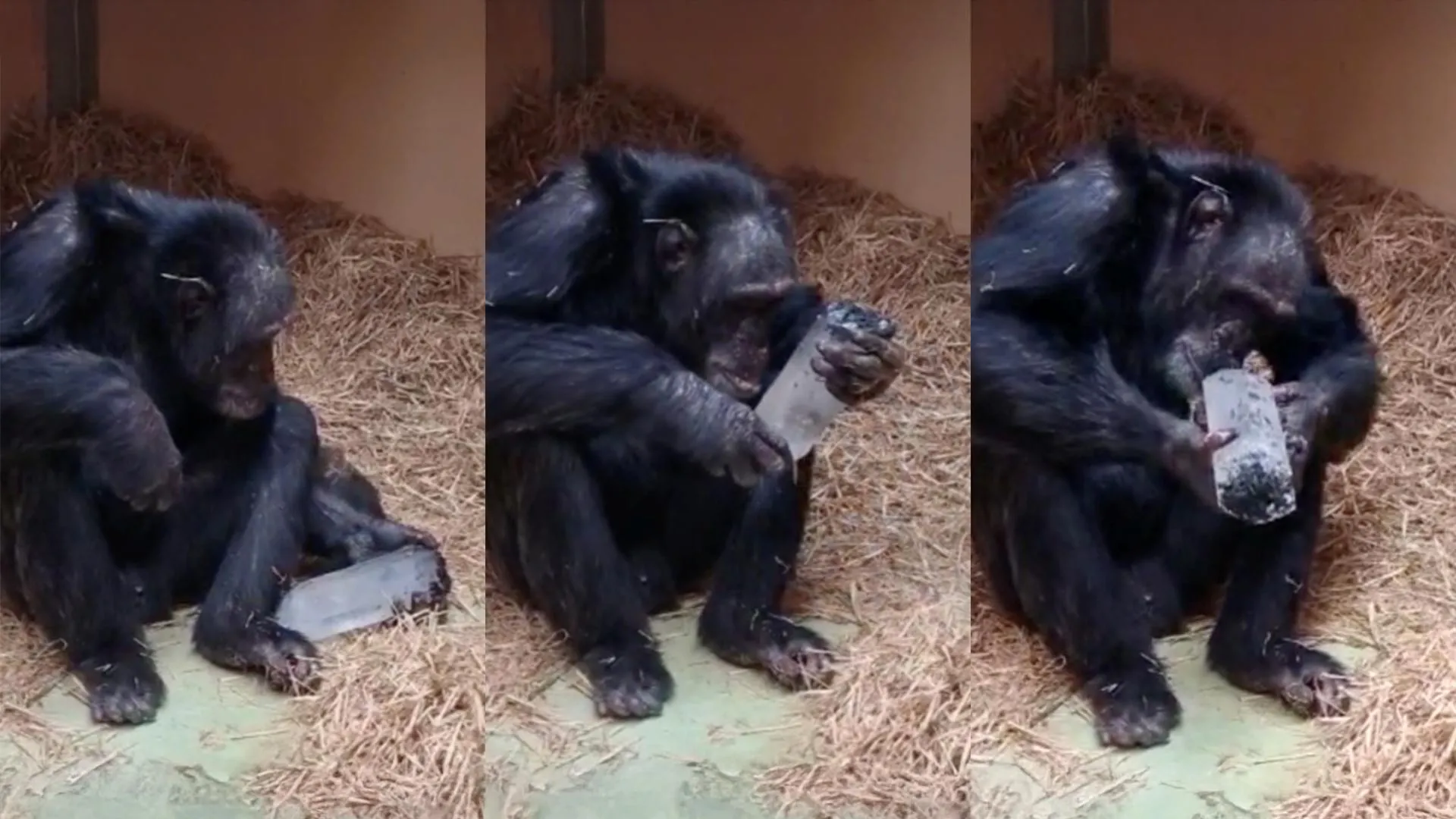
Archaeologists have documented crystals at multiple archaeological sites containing remains of early human relatives dating back approximately 780,000 years, yet these crystals showed no evidence of being fashioned into tools, weapons, or ornaments. This discovery raises questions about why ancient hominins would have deliberately preserved objects without obvious practical utility.
A study published in Frontiers in Psychology addressed this puzzle by examining crystal preference in chimpanzees, humanity’s closest living relatives. Researchers at institutions in Spain conducted experiments with enculturated chimpanzees at the Rainfer Foundation to determine whether attraction to crystals might represent a shared behavioral trait. The lead researcher, Prof Juan Manuel García-Ruiz of the Donostia International Physics Center, noted that the chimpanzees demonstrated a notably strong and seemingly instinctive preference for crystals over ordinary stones, suggesting such attraction may have ancient evolutionary origins.
In initial experiments, chimpanzees were presented with large crystals alongside similar-sized regular rocks. While both objects generated initial interest, the crystals quickly emerged as the clear preference, with chimpanzees carefully examining them by rotating and tilting them to view different angles. One individual transported a crystal back to dormitory areas. Subsequent experiments using smaller quartz crystals mixed among 20 rounded pebbles found that chimpanzees identified the crystals within seconds. When researchers introduced other crystal types with varying properties, the animals continued selecting crystal materials from stone collections, and one chimpanzee demonstrated particularly sophisticated behavior by sorting different crystal types into separate groups.
The researchers identified transparency and geometric shape as primary features driving crystal attraction in the chimpanzees studied. They noted that crystals possess distinctive flat surfaces and straight edges unlike most natural objects, making them geometrically unique within typical environments. The team suggested these distinctive visual properties may similarly have drawn the attention of early humans seeking to comprehend their surroundings. The researchers acknowledged limitations in their study, noting that future investigations should include less acculturated populations and potentially wild chimpanzees to strengthen conclusions about innate preferences.
Originally reported by ScienceDaily. Read the full story →