
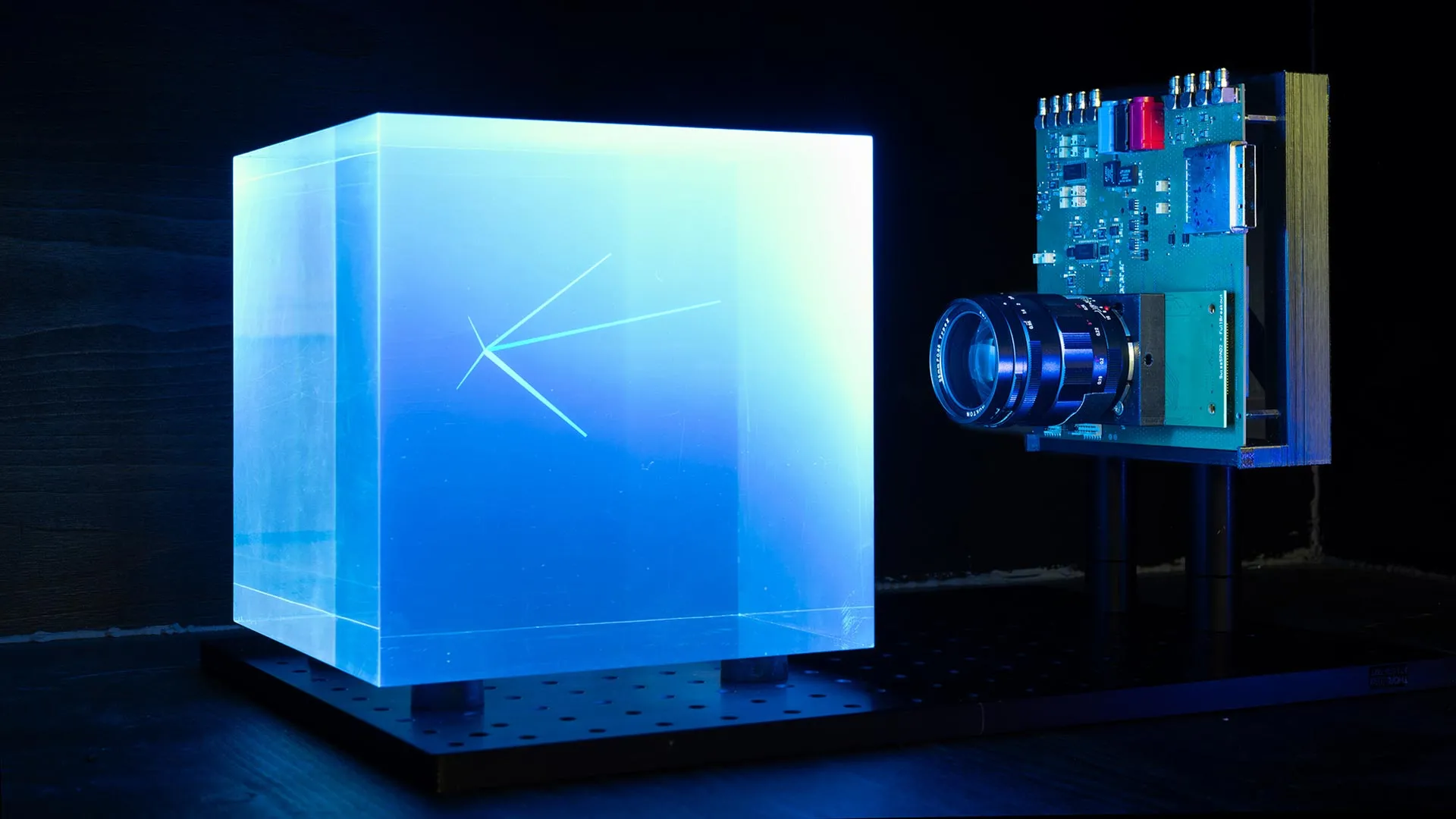
Researchers at ETH Zurich and EPFL have created a prototype detector that applies light field camera technology to particle physics, addressing a long-standing challenge in detecting weakly interacting particles such as neutrinos and dark matter candidates. Traditional particle detectors require division into millions of individual segments to achieve high spatial resolution, creating significant manufacturing and assembly complexity. The new approach, called PLATON, uses a single large block of scintillator material combined with advanced imaging technology to reconstruct particle tracks without such extensive segmentation.
The detector combines a micro-lens array with single-photon avalanche diode (SPAD) sensors, technology adapted from plenoptic or light field cameras. Light field cameras capture not only the intensity of incoming light but also its direction, enabling three-dimensional reconstruction. When paired with SPAD sensors capable of detecting individual photons, this technology proved capable of tracking particles even with extremely faint light signals. Laboratory testing demonstrated the prototype’s ability to detect electrons and achieve accurate spatial resolution using light levels as low as five detected photons.
The current PLATON prototype includes the SwissSPAD2 sensor developed by the EPFL team and incorporates gated photon detection, which records photons only during specific time windows to filter background noise. Simulations closely matched experimental measurements, validating the team’s performance models. Testing involved electrons produced using a strontium-90 source, with results confirming the detector’s effectiveness across varying light conditions.
Future iterations will incorporate improved SPAD array sensors providing sub-nanosecond timing and expanded field of view. The researchers used artificial intelligence based on Transformer neural networks to process scintillation photon patterns, enabling reconstruction of particle interactions. Simulations suggest an upgraded 10x10x10 centimeter PLATON detector could achieve sub-millimeter spatial resolution, while a one-cubic-meter version could reach a few millimeters—matching state-of-the-art detectors without extensive segmentation. The technology potentially enables spatial resolution below one millimeter in larger volumes.
Beyond particle physics applications, the team has filed three patents for using PLATON technology in positron emission tomography (PET) medical imaging. The patents cover both scanner design and image-processing techniques. This development follows a historical pattern where particle physics innovations, such as the world wide web and proton therapy, have yielded broader scientific and medical applications.