
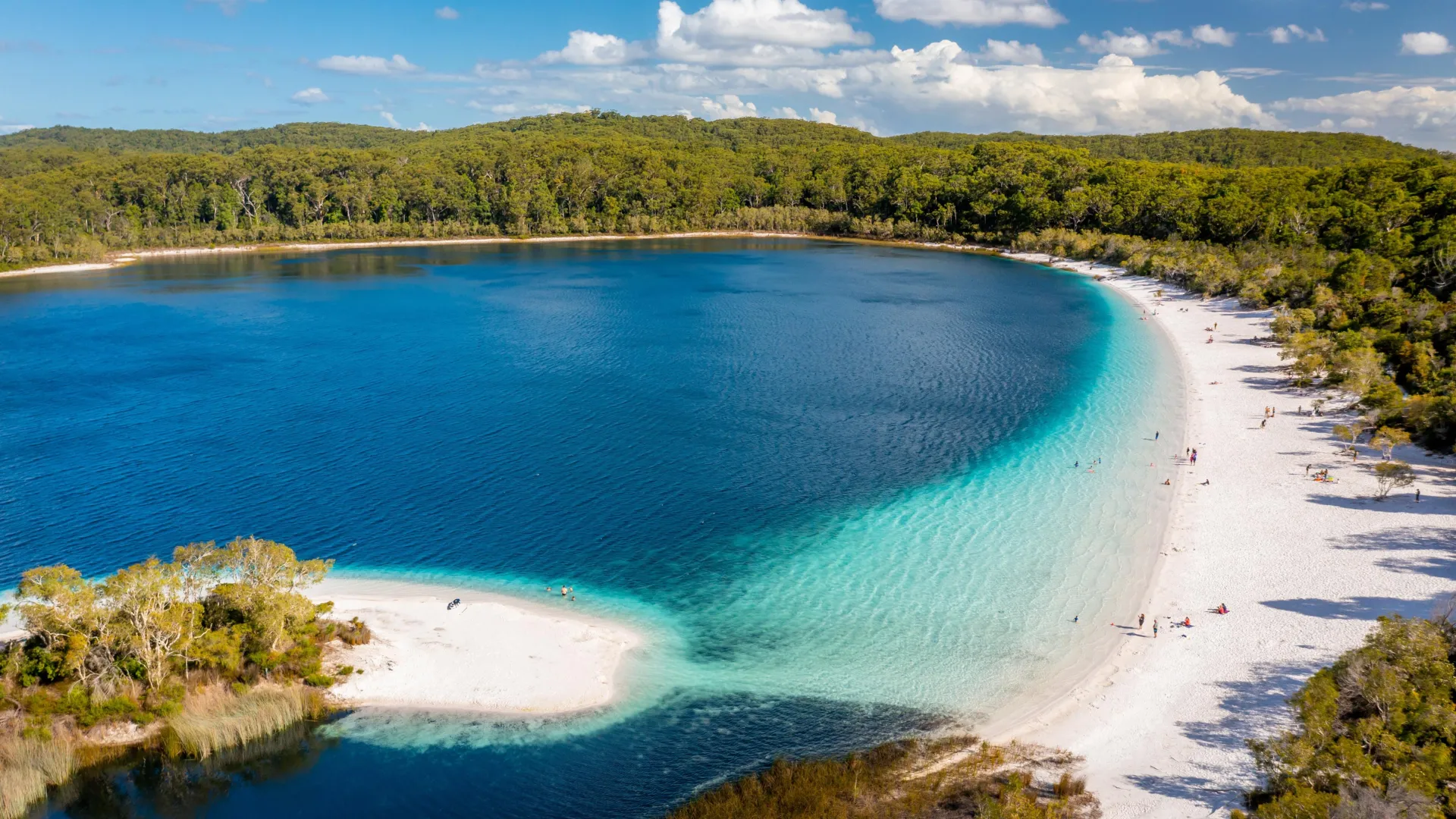
Scientists at the University of Adelaide have identified evidence that several of the world’s largest sand island’s deepest lakes experienced a drying event approximately 7,500 years ago, during the middle Holocene epoch. This period, occurring thousands of years after the last Ice Age concluded, was characterized by higher rainfall levels compared to contemporary climate conditions, making the lakes’ disappearance an unexpected finding for researchers.
The research team, led by Associate Professor John Tibby, examined sediment cores extracted from K’gari’s oldest lakes to reconstruct past environmental conditions. By analyzing the layered deposits of pollen, sand, plant remains, and organic matter that accumulate at lake bottoms, researchers identified a gap in sediment formation spanning roughly 2,000 years between approximately 7,500 and 5,500 years ago. This missing sediment layer indicated that water no longer covered portions of the lake basins during this interval, meaning the lakes had dried out.
What distinguished this drying event from typical Australian lake depletions was its occurrence during a relatively wet climate period rather than during drought conditions. The research suggests that rainfall volume alone may not determine whether these lakes persist. Co-author Dr. Harald Hofmann from the Commonwealth Scientific and Industrial Research Organisation proposed that ancient wind patterns may have redirected precipitation away from K’gari toward the nearby island of Minjerribah. South-east trade winds, which persistently blow across the region, may have channeled rainfall toward different parts of the landscape, leaving K’gari’s lakes without adequate water replenishment despite abundant regional precipitation.
These findings raise concerns about the lakes’ resilience in future climate scenarios. As climate projections indicate drier overall conditions paired with more intense individual rainfall events, researchers warn that the lakes may face new vulnerabilities. Powerful rainstorms do not guarantee adequate water recharge if precipitation falls in wrong locations, runs off rapidly, or fails to reach the groundwater systems sustaining the lakes.
For the Butchulla people, the Traditional Owners of K’gari, the lakes hold profound cultural and spiritual significance, known as The Eyes of K’gari. Study co-author Conway Burns emphasized that protecting these sacred waters remains essential for maintaining their cultural meaning and connection to Country for future generations.