
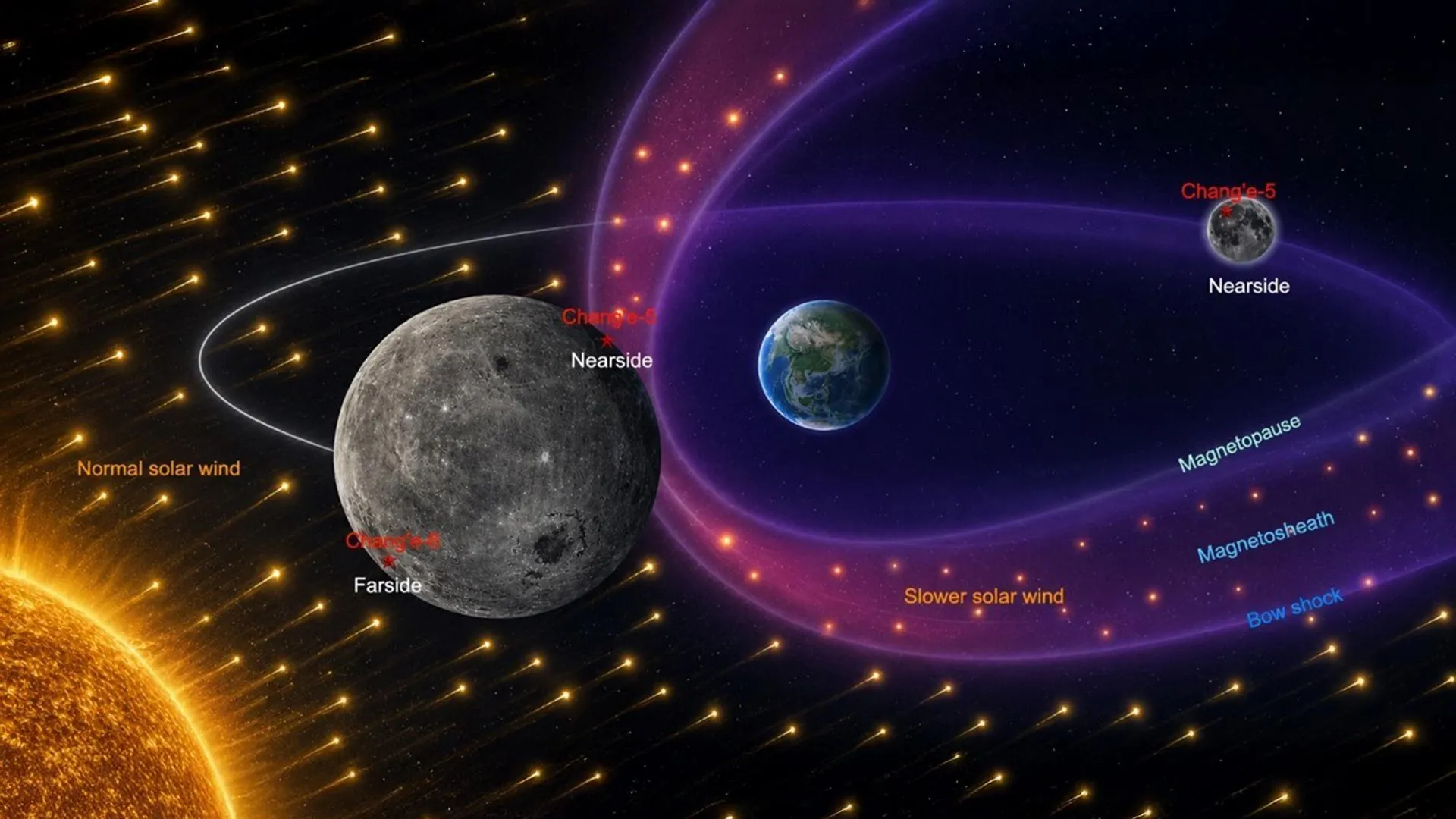
Material collected by China’s Chang’e 6 mission from the lunar far side has provided new insights into how solar wind particles interact differently with the Moon’s two hemispheres. The research, published in Nature Geoscience, analyzed samples of regolith containing noble gases that serve as markers of solar wind exposure accumulated over billions of years.
A research team led by the Institute of Geology and Geophysics of the Chinese Academy of Sciences examined concentrations and isotopic compositions of helium, neon, argon, krypton, and xenon in the 1.935-gram sample retrieved from the South Pole Aitken basin. The far side regolith displayed a notably different neon isotope ratio compared to previously studied near-side samples, with measurements showing 20Ne/22Ne ratios of 11.34 ± 0.22. This difference indicates the far side experienced more intense isotopic fractionation, suggesting exposure to different solar wind conditions.
Stepwise heating experiments revealed additional contrasts between hemispheres. Xenon released from far side material concentrated at high temperatures, suggesting particles penetrated much deeper into the regolith. Near side samples from earlier missions showed xenon released across both low and high temperature ranges, indicating shallower implantation depths. These patterns suggest the Moon’s far side was exposed to faster, more energetic solar wind particles capable of traveling farther into the lunar surface.
Researchers attribute the hemispheric differences to Earth’s magnetosphere, which creates a magnetosheath region that slows the solar wind to approximately half its normal speed of 400 km/s. The Moon’s near side, which faces Earth, experiences this reduced solar wind velocity roughly 25 percent of the time as the Moon orbits, resulting in lower-energy particle implantation. The far side, permanently facing away from Earth, remains exposed to the full-speed solar wind without this protective effect.
The findings suggest that noble gases preserved in lunar soil could serve as records of Earth’s magnetic history, potentially offering new methods to trace long-term changes in Earth’s magnetosphere when combined with paleomagnetic evidence.