
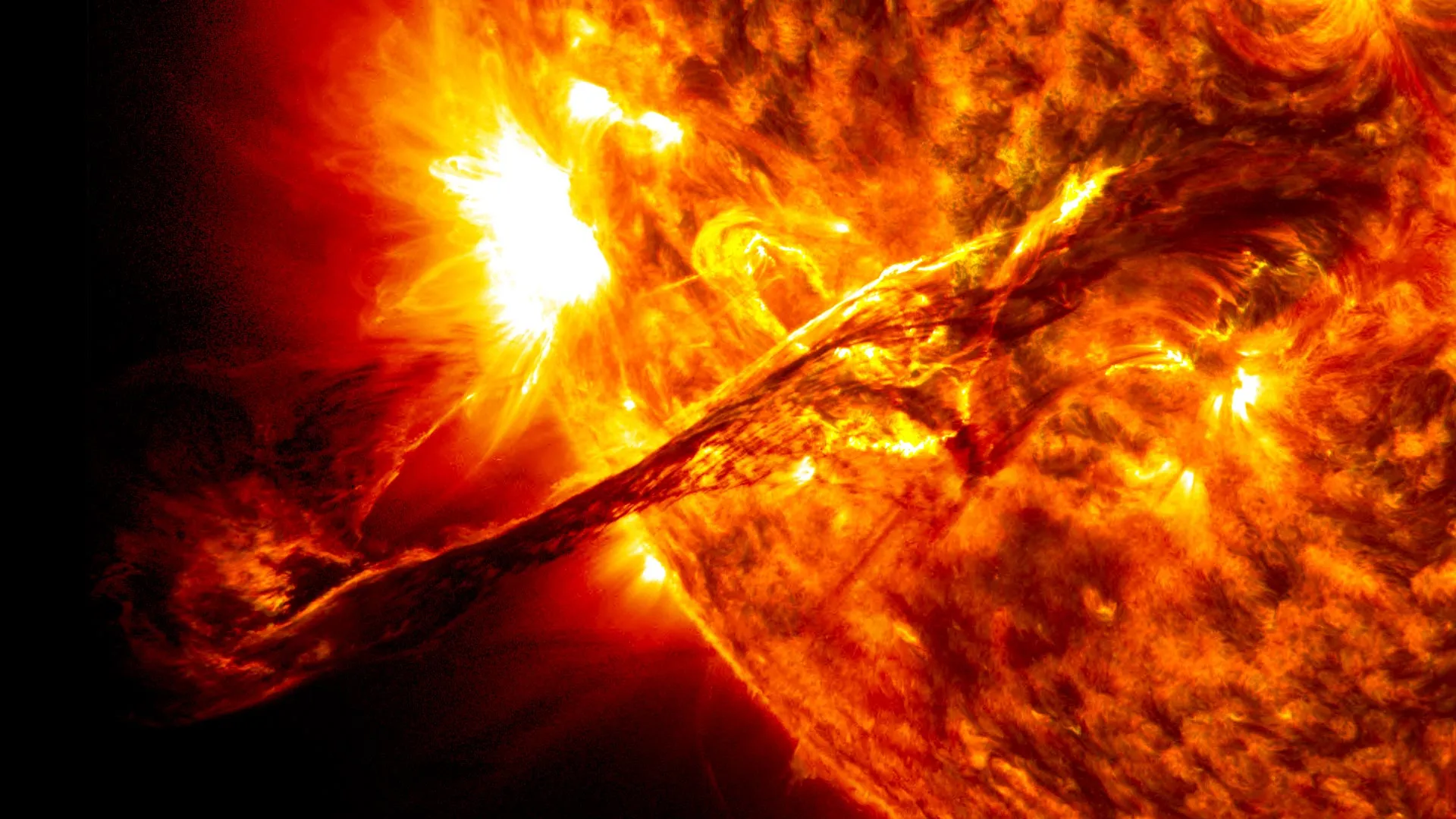
Researchers at the University of Warwick have developed a method to forecast the strength of solar cycles up to seven years in advance by identifying a previously unknown switch-off point where extreme space weather ends abruptly. The technique examines sunspot counts at this critical stage and correlates them with the peak sunspot activity expected during the subsequent cycle, providing significantly earlier warning than conventional forecasting approaches that require observations at solar minimum.
Using this new methodology, scientists have generated an early projection for Solar Cycle 26, suggesting it will likely be moderate with approximately 100 to 120 sunspots, potentially comparable to or slightly weaker than the current Solar Cycle 25. However, researchers acknowledge that accuracy will improve substantially within about two years, when Solar Cycle 25 reaches the identified switch-off point, allowing calculations based on direct observations rather than estimates.
The research builds upon Professor Sandra Chapman’s earlier work developing a standardized “sunclock” that maps the Sun’s irregular cycles into a consistent framework. The discovery that extreme space weather terminates at a defined stage rather than gradually fading opens new insights into solar behavior. The switch-off occurs when active sunspot regions migrate below approximately 15 degrees solar latitude, where differential rotation weakens and a co-rotating jet stream region forms around the solar equator.
The method successfully predicted that Solar Cycle 25 would be more active than many earlier forecasts suggested, leading to the auroral displays observed in recent years. Most notably, historic geomagnetic storms struck the UK in 2024, producing the strongest magnetic disturbances in over two decades and creating northern lights visible as far south as Devon and Cornwall. By understanding when powerful coronal mass ejections cease being driven by differential rotation, scientists may gain deeper comprehension of the solar dynamo mechanism that generates and maintains the Sun’s magnetic field.