
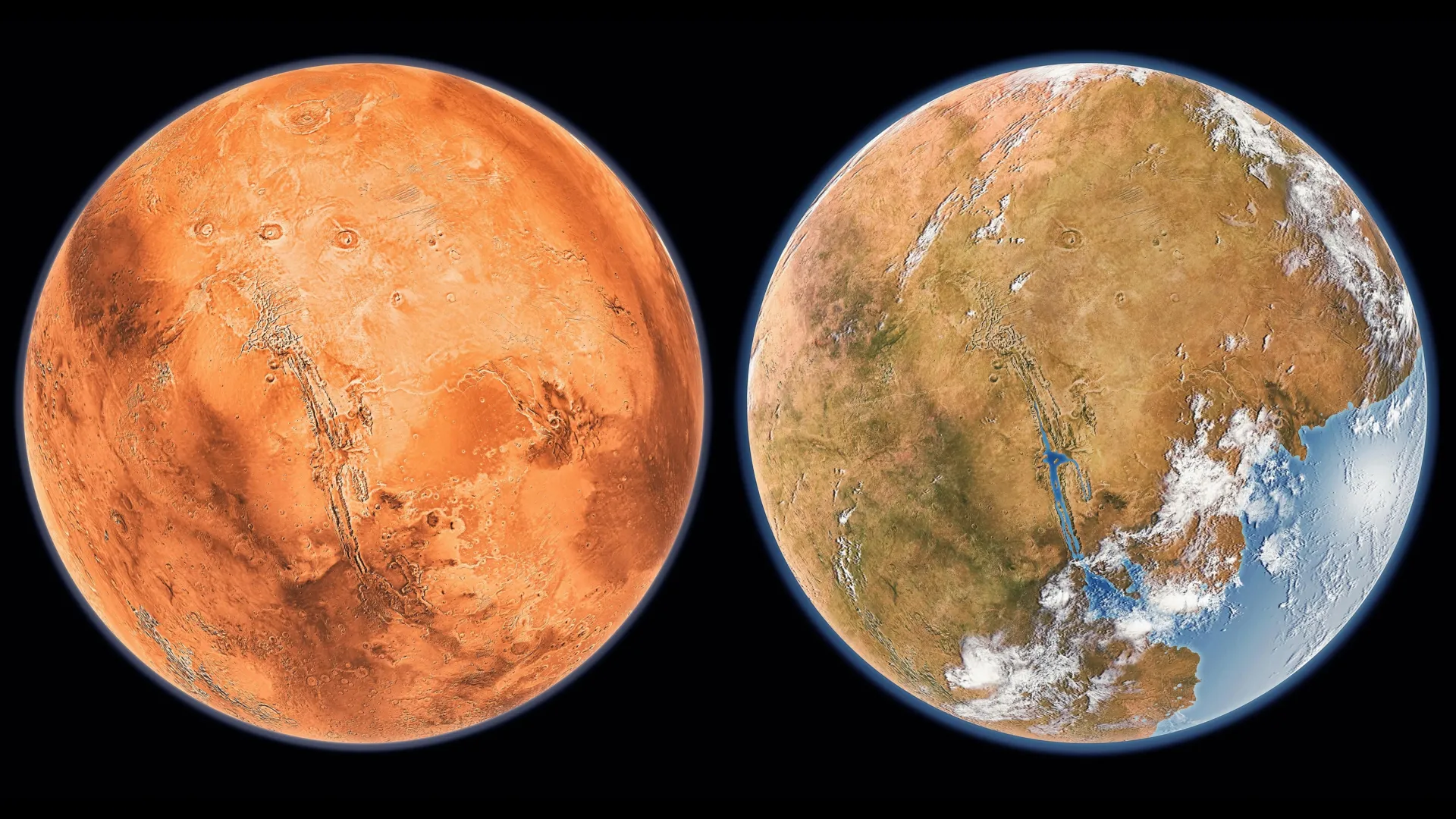
A new workshop summary contends that terraforming Mars—the process of reshaping the planet to support Earth-like life—should be treated as a serious area of scientific inquiry rather than pure speculation. Dr. Erika DeBenedictis, CEO of Pioneer Labs, prepared the summary for the 2025 Green Mars Workshop, arguing that technological breakthroughs have fundamentally altered the assessment of feasibility. Key developments include potentially dramatic reductions in launch costs from SpaceX’s Starship alongside advances in synthetic biology and climate modeling, shifting the focus from whether terraforming is physically possible to whether it should be pursued and how to do so safely.
The proposed approach begins by envisioning a habitable Mars and then works backward to identify necessary steps. The initial phase would involve warming the planet by several tens of degrees Celsius over a few decades using engineered aerosols or greenhouse gases. Mars contains sufficient frozen water reserves that could eventually form an ocean covering nearly four million square kilometers, and raising temperatures by approximately 30 degrees Celsius could trigger melting of these ice sheets to create stable liquid water on the surface.
Subsequent stages would introduce engineered extremophile microorganisms designed to survive Mars’s harsh conditions. These specially modified organisms could potentially spread across the planet within decades, beginning the slow atmospheric transformation through photosynthesis. However, creating an oxygen-rich atmosphere capable of supporting complex life would require centuries or longer, with researchers proposing massive domed habitats roughly 100 meters tall as initial staging areas where breathable oxygen could be produced through photosynthesis or water electrolysis.
The summary identifies several critical scientific unknowns requiring resolution before any large-scale effort could proceed, including the composition beneath Mars’s ice sheets, how dust storms might respond to warming and increased moisture, and whether the planet contains sufficient materials for water electrolysis or if resources would need transport from Earth. Beyond technical challenges, terraforming raises significant ethical concerns about permanently erasing aspects of Mars’s natural history, potentially destroying indigenous microbial life if it exists, and limiting future scientific study of the planet in its original state. Researchers emphasize that studying terraforming could yield practical benefits for Earth, including development of desiccation-resistant crops and efficient closed-loop life support systems applicable to terrestrial sustainability challenges.
The workshop does not advocate immediate terraforming efforts but rather calls for careful laboratory research, advanced climate modeling, and small-scale experiments on future Mars missions to explore localized warming techniques before any planetary-scale transformation is attempted.
Article Attribution | Read More at Article Source
Article summary produced by Claude AI