
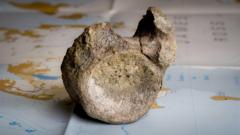
A fossil specimen that remained unstudied for four decades in the British Antarctic Survey’s collection in Cambridge has been identified as the first dinosaur bone ever discovered in Antarctica. The tail vertebra was originally collected on James Ross Island in 1985, but the team that found it could not definitively identify the specimen at the time and placed it in storage alongside thousands of other Antarctic specimens.
The fossil was recently spotted by Dr Mark Evans, the collections manager at BAS, who recognized its distinctive characteristics. Evans consulted Prof Paul Barrett from the Natural History Museum, who confirmed the bone belonged to a Titanosaur, a group of massive long-necked herbivorous dinosaurs. The vertebra displayed unique ball-and-socket joint features that are specific to this dinosaur family. Based on the size of the tail bone, researchers estimate the Antarctic specimen measured approximately 23 feet in length, suggesting it may have been either a juvenile or a smaller species within the group.
The dinosaur inhabited Antarctica during the Late Cretaceous Period, approximately 82 million years ago, when the continent featured a dramatically different climate and landscape. Rather than the frozen environment of today, Antarctica was then covered in dense forests that provided abundant vegetation for plant-eating dinosaurs. The discovery offers valuable insights into prehistoric ecosystems in one of Earth’s most remote regions, where the fossil record remains sparse due to challenging working conditions and extensive ice coverage.
While other dinosaur fossils have been recovered from Antarctica since 1985, they remain relatively rare. The confirmation of this specimen’s identity, detailed in a paper published in the journal Acta Palaeontologica Polonica, demonstrates how paleontological knowledge can be refined through reexamination of existing collections and highlights the scientific importance of preserving materials from polar expeditions.
Article Attribution | Read More at Article Source
Article summary produced by Claude AI