
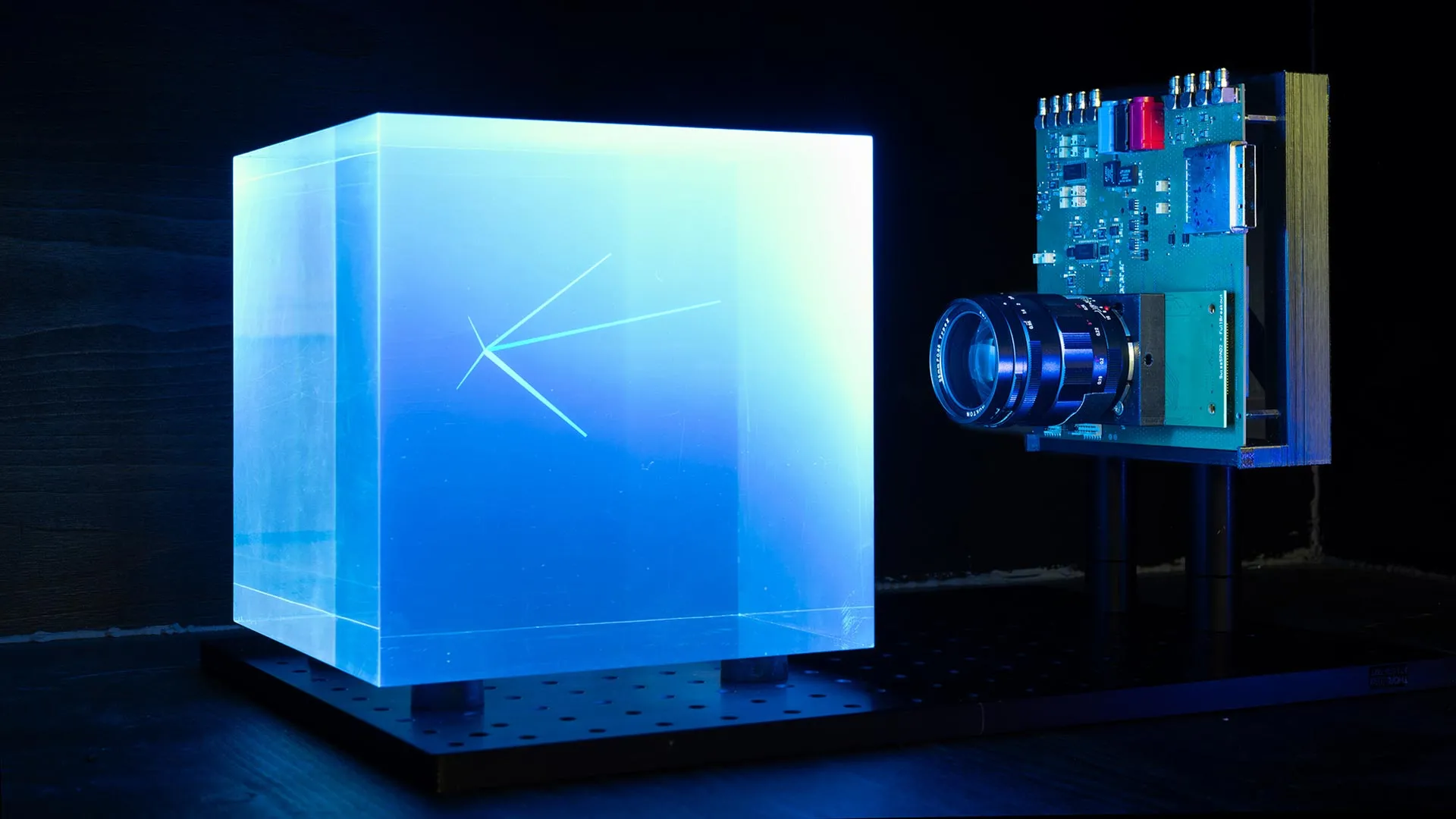
Scientists at ETH Zurich and EPFL have created a novel particle detector that combines established imaging technologies in a new way to address longstanding challenges in detecting weakly interacting particles such as neutrinos and dark matter candidates. Traditional particle detectors require dividing sensitive material into millions of small segments connected to individual optical fibers and photomultiplier tubes, an approach that becomes increasingly difficult and expensive as detectors scale up. The T2K experiment in Japan, for example, uses approximately two million small cubes and 60,000 fibers, while experiments at CERN and the Paul Scherrer Institute employ millions of thin scintillating fibers to achieve sub-millimeter precision.
The new PLATON detector takes a fundamentally different approach by keeping the scintillator material as a single unsegmented block and using advanced camera technology to determine where light originated within it. The system builds upon plenoptic camera technology, which captures not only light intensity but also the direction from which light arrives, enabling three-dimensional reconstruction. The detector combines a micro-lens array with a single-photon avalanche diode imaging sensor called SwissSPAD2, developed by the EPFL team. The sensor’s gating capability allows it to record photons only during specific time windows, filtering out background noise while focusing on genuine scintillation signals. Laboratory testing demonstrated the system could function effectively even with extremely faint light levels, down to approximately five detected photons.
The research team has already begun developing improvements to enhance the detector’s performance. A new SPAD array sensor under development will provide better photon detection efficiency and assign precise time stamps to individual photons rather than grouping them into fixed windows. Optimized optical designs aim to expand the field of view and collect more light. Simulations incorporating neural network-based image processing indicate that an upgraded ten-centimeter cubic PLATON detector could achieve spatial resolution below one millimeter, while a one-cubic-meter version might reach a few millimeters of resolution—comparable to state-of-the-art segmented detectors but without requiring millions of individual components.
The technology has already attracted interest beyond fundamental physics research. Researchers have filed three separate patents for applications in positron emission tomography, a medical imaging technique that tracks radioactive tracers within the body. The patents cover both scanner design and image-processing techniques developed for particle detection. This extension follows a historical pattern in which particle physics experiments have led to broader technological applications, including the creation of the World Wide Web at CERN and the development of proton therapy from particle accelerator research.
Article Attribution | Read More at Article Source
Article summary produced by Claude AI