
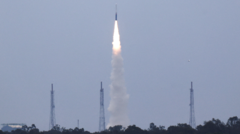
Skyroot Aerospace achieved a significant milestone in India’s space sector by successfully launching Vikram-1 from the Indian Space Research Organisation’s facility in Sriharikota on Saturday. The seven-storey rocket reached Low Earth Orbit at an altitude of 280 miles following a 16-minute flight, making Skyroot the first Indian private company to accomplish an orbital launch. This achievement positions India as only the third country, after the US and China, to have a private company capable of orbital launches.
The launch carried six payloads into orbit, including scientific instruments and symbolic items. Among the payloads were a robotic arm designed for space debris removal, an Earth observation camera, and satellites from various sources including a German company. The mission, designated Aagman, also carried two symbolic payloads that generated attention within India: a lotus flower crafted from lab-grown diamonds and a miniature gold rocket featuring micro-sculptures of three prominent Indian scientists smaller than a grain of rice.
Skyroot’s business model centers on offering dedicated small-lift launch services, which company leadership describes as a “cab service to space.” Rather than requiring satellite operators to wait months or years for space aboard large rockets with fixed schedules, the company aims to provide tailored missions to specific orbits. Co-founder and CEO Pawan Kumar Chandana indicated the company can manufacture one rocket monthly at its Hyderabad facility and plans two additional test flights this year before beginning commercial operations next year.
The company was founded in 2018 by Chandana and Naga Bharath Daka, both former colleagues at India’s space agency. Skyroot recently achieved unicorn status with a $1.1 billion valuation, becoming India’s first space-technology unicorn. The launch occurs within the context of India’s broader space ambitions, which include planned astronaut missions, a Venus orbiter by 2028, and a domestic space station by 2035. Chandana indicated that while some missions could support India’s space programs, the company expects 70-80% of its market to serve global customers requiring satellite services for agriculture, fisheries, disaster management, communications, and security applications.
Article Attribution | Read More at Article Source
Article summary produced by Claude AI