
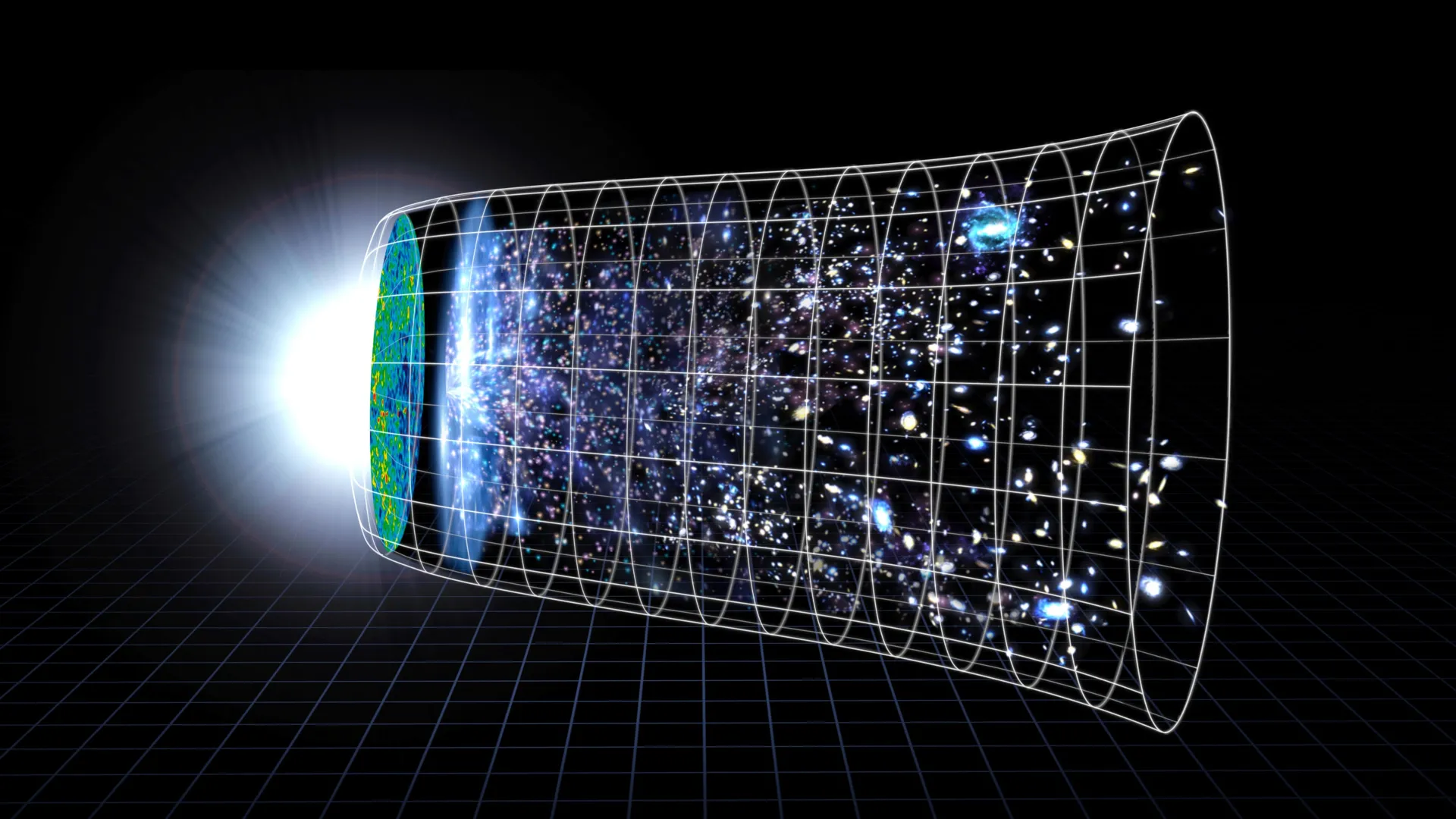
The expansion of the universe creates fundamental challenges in measuring cosmic distances because space itself continues to grow as light travels from distant galaxies toward Earth. Light from remote sources may require billions of years to reach us, during which cosmic expansion continuously increases the average separation between galaxies. When astronomers observe a distant galaxy through a telescope, they are viewing it as it appeared in the past, not as it exists today. To determine a galaxy’s current position, researchers must apply cosmological models that account for the universe’s historical expansion.
The current leading model, known as LCDM, incorporates dark matter and dark energy to explain observed cosmic phenomena. A key concept in this framework is the observable universe’s boundary, referred to as the particle horizon or comoving horizon. The universe measures approximately 13.77 billion years old, yet the most distant observable regions now exist approximately 45 billion light-years away. This apparent contradiction resolves when considering that space itself has expanded throughout the time light has been traveling toward us.
Unlike nearby objects, which cannot exceed the speed of light according to Einstein’s special relativity, distant galaxies may recede faster than light because space itself is expanding rather than objects moving through static space. Astronomers measure galactic recession rates using redshift, the stretching of light toward longer wavelengths as sources move away. The Hubble distance, located roughly 13.77 billion light-years away, marks the point where galaxies begin receding faster than light. However, observations of galaxies beyond this threshold remain possible because their light was emitted when they were nearer to us.
A more restrictive boundary exists at the cosmological event horizon, currently about 17 billion light-years distant. Light emitted from beyond this threshold today will never reach us regardless of elapsed time, as cosmic expansion will prevent it from bridging the growing distance. Dark energy accelerates this expansion, with the cosmological event horizon expected to approach approximately 60 billion light-years in the distant future. As expansion continues, light from remote galaxies will become increasingly redshifted until it effectively vanishes from observation, leaving future astronomers with a dramatically diminished view of the cosmos.
Article Attribution | Read More at Article Source
Article summary produced by Claude AI