
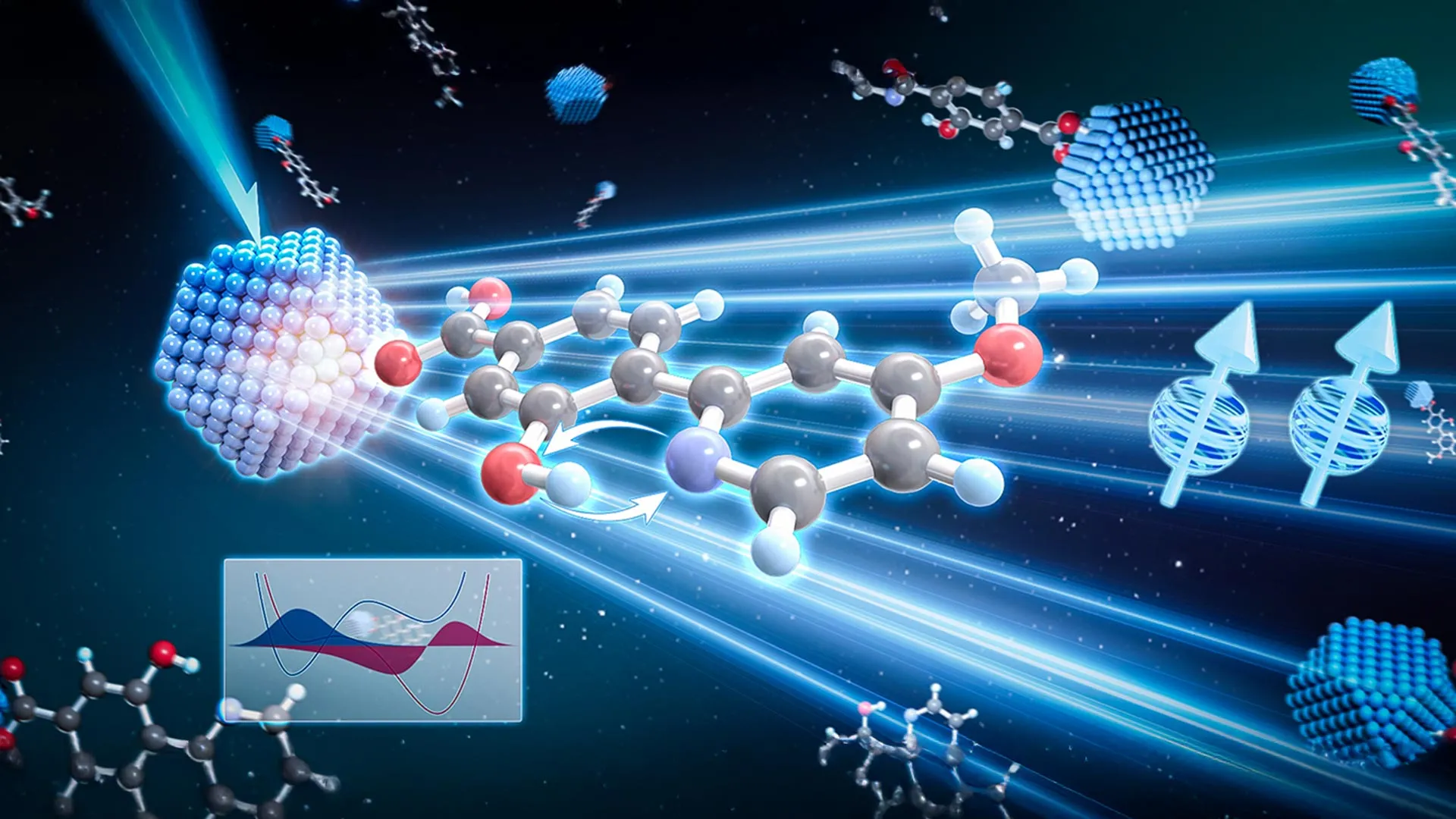
Scientists at the Dalian Institute of Chemical Physics of the Chinese Academy of Sciences have identified a previously unknown mechanism governing how energy moves through materials when protons and electrons move in coordination. The discovery, published in Nature Materials, reveals a process termed proton shuttle-assisted triplet energy transfer (PS-TET) that operates in systems where light-absorbing quantum dots are coupled with molecular acceptors.
The research builds on established understanding of related processes in both biological and engineered systems. While proton-coupled electron transfer (PCET) and proton-coupled singlet energy transfer (PCEnT) have been studied extensively, the mechanism linking proton motion to triplet energy transfer remained poorly understood until now. The team observed the PS-TET process occurring as energy transferred from zinc selenide-based quantum dots to organic molecular acceptors attached to their surfaces.
When the quantum dots absorbed light and entered an excited state, a proton temporarily shifted position within the attached molecules while electrons and holes simultaneously transferred. This coordinated motion enhanced both the speed and efficiency of energy transfer compared to systems lacking the proton shuttle mechanism. Notably, the rate of this process remained relatively constant across different temperatures, suggesting the proton movement occurred through quantum mechanical tunneling rather than conventional heat-driven diffusion. Calculations of proton vibrational wavefunction overlap confirmed this interpretation, indicating that quantum effects can control energy transfer in materials even at ambient conditions.
The findings carry significant implications for multiple technological applications. In some contexts, enhanced triplet state generation could improve performance in catalysis and photoredox reactions. Conversely, in optoelectronic devices like solar cells and lasers, limiting triplet formation often improves function. The research suggests scientists can now potentially control triplet generation by either introducing or removing the proton shuttle mechanism as needed for specific applications.
Article Attribution | Read More at Article Source
Article summary produced by Claude AI