
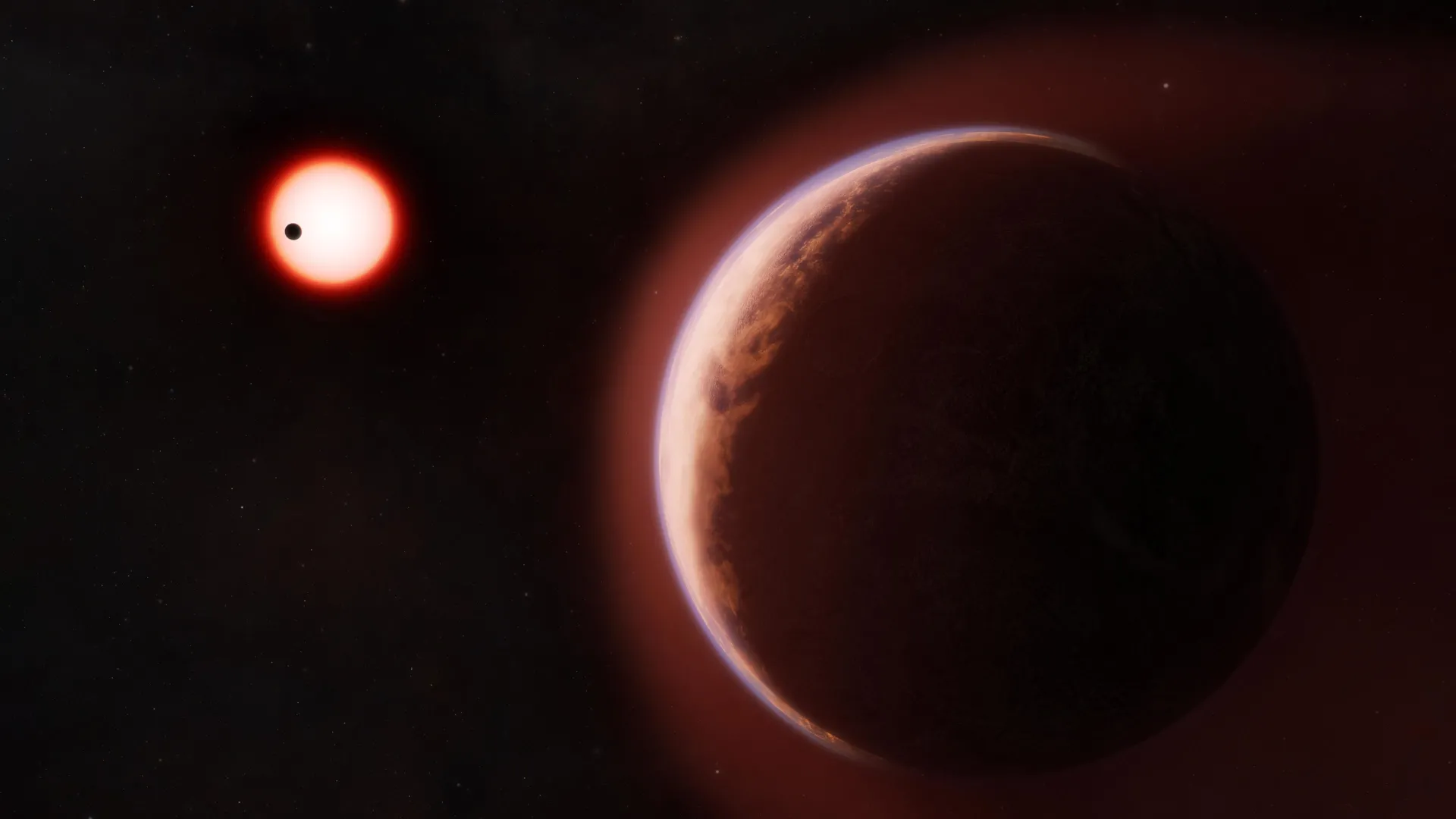
Researchers have announced the detection of an atmosphere on LHS 1140 b, a rocky exoplanet located approximately 48 light-years from Earth, marking a significant advancement in the search for potentially habitable worlds beyond the solar system. The planet orbits within the habitable zone of a red dwarf star, a region where conditions may permit liquid water to exist on a planetary surface.
The discovery, published July 16 in Science, was made by analyzing helium escaping from the planet’s upper atmosphere using the Warm Infrared Echelle Spectrograph at the Magellan Observatory in Chile. Collin Cherubim, lead author of the study, and his colleagues developed a theoretical model predicting that LHS 1140 b would retain helium in its atmosphere. The researchers verified this prediction during an unusual astronomical event when LHS 1140 b and another planet crossed in front of their star on the same night. While the second planet showed no atmospheric signature, LHS 1140 b produced a clear signal consistent with atmospheric helium, providing evidence that the world has retained an atmosphere.
The achievement represents a major milestone in exoplanet research, as scientists have previously identified thousands of exoplanets, including several rocky worlds within habitable zones, but confirming atmospheres on these distant bodies has proven exceptionally challenging. Astronomers estimate that LHS 1140 b’s atmosphere has persisted for more than three billion years, making it an especially valuable target for further study.
The findings suggest that ground-based observation of atmospheric compositions on rocky exoplanets may be feasible by detecting gases escaping into space. Cherubim and his team plan to conduct additional observations to determine the complete chemical composition of LHS 1140 b’s atmosphere and assess features such as surface oceans that could indicate habitability. Researchers also intend to apply their model to identify other rocky worlds with retained atmospheres.
Article Attribution | Read More at Article Source
Article summary produced by Claude AI