
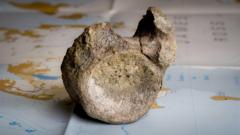
Paleontologists have confirmed that a fossil specimen collected from James Ross Island in 1985 represents the first dinosaur bone ever discovered in Antarctica. The specimen had been stored in the geology collection of the British Antarctic Survey in Cambridge for 40 years after its initial discovery, as the original research team was uncertain about its classification.
Dr. Mark Evans, the collections manager at the British Antarctic Survey, recently identified the fossil while reviewing thousands of specimens from Antarctic expeditions. The specimen was originally documented by geologist Dr. Mike Thomson in a field notebook dated 9 December 1985, where it was described as a vertebra of a large reptile measuring approximately 10 centimeters wide. Evans recognized distinctive dinosaur characteristics in the bone and consulted Prof. Paul Barrett from the Natural History Museum to confirm the finding.
Barrett identified the fossil as a tail vertebra from a Titanosaur, a group of massive four-legged herbivorous dinosaurs known for their long necks and counter-balancing tails. Based on the vertebra’s dimensions, scientists estimate the Antarctic specimen was approximately 23 feet in length, suggesting it may have been either a juvenile or a genuinely small adult member of the species. More than 100 Titanosaur species have been identified worldwide, with the largest members exceeding 115 feet in length.
The dinosaur lived 82 million years ago during the Late Cretaceous Period when Antarctica featured a dramatically different climate with lush forests and abundant vegetation suitable for large herbivores. The discovery contributes valuable information to the sparse fossil record of Antarctica, a region where paleontological fieldwork remains challenging due to extensive ice coverage. The finding was published in the journal Acta Palaeontologica Polonica.
Article Attribution | Read More at Article Source
Article summary produced by Claude AI